
This article presents a methodology for accelerating an organization’s transition to an AI-ready state – a condition of preparedness for the systematic implementation of artificial intelligence (AI). The approach integrates composable architecture and data mesh, unified and orchestrated by an enterprise digital twin (EDT). We argue that the EDT serves a dual function: as a tool for describing and managing a modular enterprise architecture, and as an orchestrator for data mesh and MLOps structures. The article examines the limitations of traditional digital transformation, outlines key principles of modularity, and provides several industry examples. We conclude that this integrated approach is critical for enhancing agility, reducing implementation timelines, and mitigating transformation risks, particularly in complex regulatory and economic environments.
Introduction
The journey to integrating artificial intelligence (AI) into large organizations demands a comprehensive overhaul of processes, data, and infrastructure. Global practice identifies several maturity levels:
- AI-Ready: The organization has a prepared architecture of data, processes, and tools, enabling the rapid launch and scaling of AI projects.
- AI-First: Key business processes and products are designed with the prioritized use of descriptive, prescriptive and generative AI.
- AI-Native: AI is integrated into the very foundation of the business model, introducing novel capabilities to deliver AI as a service.
For traditional companies, reaching the AI-ready state is a prerequisite for advancing to higher maturity levels. This requires architectural solutions that ensure flexibility, consistency, and manageability of change.
Crucially, without a coherent architectural framework and a transformation management system, investments required to make a company AI-ready can easily surpass the potential benefits of AI implementation over a multi-year horizon.
The Challenges of AI Implementation
Organizations lacking a purpose-built architecture for digital initiatives face common barriers:
- Prolonged Preparation Timelines: Upgrade and adaptation of legacy corporate systems – necessary for industrial AI deployment – can take over three years.
- High Capital Expenditure: Modernizing infrastructure and integrating each new solution often requires significant investment counted in million dollars.
- Solution Duplication: In the absence of an architecture consistency, departments develop their own data pipelines, services, and models, leading to silos and inefficiency.
- Increased Risk: Errors in large IT projects that lack a product-oriented approach and phased implementation can slow down or derail the entire transformation.
These challenges necessitate a structural approach to achieve an AI-ready (and subsequently AI-first) state faster, cheaper, and with lower risk than a classic transformation allows.
Methodology: Key Concepts and the Role of the EDT
Composable Enterprise
This is an architectural approach where business functions, processes, data, and services are implemented as autonomous, reusable modules with well-defined interfaces, ensuring flexibility and adaptability. The key principle is capability alignment – mapping modules directly to the organization’s business capability map (Ross et al., 2006; Gartner, 2020).
Data Mesh
A decentralized and federated data management architecture where data is treated as a product (data-as-a-product), and ownership is distributed among domain-oriented teams. Foundational elements include a unified data catalog, standardized access interfaces, and integration with the overall enterprise architecture (Dehghani, 2022).
MLOps
A set of practices, tools, and processes that automate the full machine learning lifecycle – from development and training to deployment, monitoring, and updating. The goal is to reduce time-to-production while maintaining model quality and reproducibility (Feurer et al., 2021).
Enterprise Digital Twin (EDT)
A dynamic digital model of an enterprise that includes data on processes, resources, KPIs, and interactions. Updated in near real-time, it allows for simulation, forecasting, and optimization of operations, covering the entire organization and its ecosystem (Grieves, 2014; Tao et al., 2019).
The Orchestrating Role of the EDT
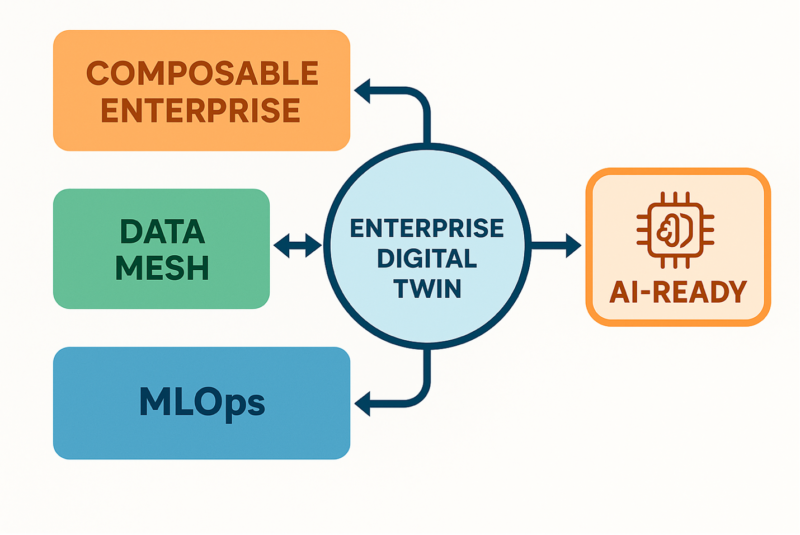
The EDT is the linchpin that integrates these three architectural components:
- Managing Composable Enterprise: The EDT captures the structure of enterprise assets, their linkage to business capabilities, and their interconnections. This ensures capability alignment, controls change, and provides transparency into the IT landscape, allowing new functions to be added without compromising architectural integrity.
- Orchestrating Data Mesh: The EDT describes data domains, assigns responsible owners, and defines SLAs and interface standards. This guarantees data availability and quality for all modules, eliminates duplication, and enhances the security of information exchange. It also adopts composability by aligning data assets and the owners to business capabilities and their stakeholders, which usual become the data owners themselves.
- Integrating with MLOps: The EDT tracks the lifecycle of AI-models, their connection to specific data products, and the business capabilities they serve. This enables the rapid, safe deployment of the models and AI-agents, allows for performance monitoring, and facilitates updates without causing failures in dependent components.
The abstract formula (Composability + Data Mesh + MLOps) × EDT = AI-Ready illustrates the systemic principle: the presence of an EDT that describes, manages, and integrates the three components is what enables an organization’s readiness for AI at scale. See Figure 1.
Examples and Practical Effects
Speed: From Experiments to Systemic AI in Months, Not Years
- Sber in Russia uses a modular AI platform and data mesh to run dozens of AI pilots in parallel. They have ambitious strategy to embed AI into every capability.
- Siemens reduced AI implementation time in its factories from 18 to 3 months using digital twins with open interfaces. The effect is a 4-6x faster transition from pilot to industrial AI-ready.
Economy: Budget Optimization through Focused Investment
- Unilever reduced AI implementation costs by 40% by using a common data platform across 300+ factories. The effect is a 30-50% reduction in Total Cost of Ownership (TCO) by eliminating duplication.
Reliability: Risk Reduction through Phased Implementation
- Tesla started with AI for autopilot in a single model (Model S) and then scaled the experience across all vehicles. The effect is a 60-70% reduction in strategic risks (per McKinsey data).
Discussion
Unlike traditional architectural methodologies (e.g., TOGAF, Zachman), the composable enterprise approach, managed via an EDT, connected with data mesh, provides not only technological but also organizational flexibility. Capability alignment ensures every module and data product works towards strategic goals, not isolated local tasks. For companies operating under constraints, this approach reduces dependence on monolithic foreign platforms and eases the transition to domestic technological solutions.
Conclusion
The key attributes of a successful AI-ready organization are:
- Speed of Model/Agent Deployment: A modular architecture enables rapid launch and scaling of AI projects.
- Data Availability and Quality: A Data Mesh ensures structured storage, clear data ownership, and standardized access.
- Solution Reliability and Reproducibility: MLOps guarantees quality control and shortens the model update cycle.
- Strategic Alignment: Capability alignment and visualization within the EDT maintain a clear link between architecture and business goals.
- Solution Autonomy: A phased, modular implementation reduces costs and localizes potential failures.
The proposed methodology syntesis composable enterprise, data mesh, and MLOps practices under the governance of an enterprise digital twin. It provides a rational framework to enable key AI-readiness attributes and thus maximizes the positive business impact of AI, specifically addressing future scalability challenges given generative AI and multi-agent frameworks.
![]() References
References
- Podymov P.V. (2025). Enterprise Digital Twin: Business Capability Maps and Artificial Intelligence in Managing Multi-Industry Ecosystems.
- Ross J.W., Weill P., Robertson D. (2006). Enterprise Architecture as Strategy: Creating a Foundation for Business Execution.
- Grieves M. (2014). Digital Twin: Manufacturing Excellence through Virtual Factory Replication.
- Tao F., Zhang H., Liu A., Nee A.Y.C. (2019). Digital Twin in Industry: State-of-the-Art.
- Dehghani, Z. (2022). Data Mesh: Delivering Data-Driven Value at Scale.
- Feurer et al. (2021). MLOps: Methodologies and Tools.
- Gartner. (2020, 2023). Research on the Composable Enterprise.
- Siemens AG. (2023). White Paper on AI and Digital Twins in Manufacturing.
Applied Data Governance Practitioner Certification
Validate your expertise and take your career to the next level.