Key Takeaways
- Privacy-preserving access to sensitive data is a prerequisite for enterprise-scale AI adoption, not a compliance afterthought.
- Organizations are not struggling to connect AI to data. They are struggling to connect AI to sensitive data safely.
- MCP is a useful integration pattern for AI agents, but it is not a governance layer by itself.
- Data masking is one of the most mature mechanisms available to bridge the gap between AI capability and enterprise trust.
- AI-assisted stewardship works best when recommendations and execution are separated by policy, workflow, validation, and audit.
- The biggest barrier to enterprise AI adoption is not model capability. It is trust. Privacy-preserving controls accelerate that trust.
- The goal is not unchecked autonomy. The goal is governed action at enterprise speed.
The Shift from AI Answers to AI Actions
Most enterprise AI conversations still start with better answers: better search, better summaries, better copilots, and better natural-language access to enterprise knowledge. Those capabilities matter. But for data leaders, they are only the opening act.
The harder question is what happens when AI moves from answering questions to initiating action. A chatbot can summarize a supplier record. An agent can identify missing fields, recommend a correction, prepare a stewardship task, and route the exception to the right person. That is a different risk profile entirely.
Enterprise data is not just content to be retrieved. It is the operating layer behind orders, invoices, compliance reports, supply chains, customer experiences, and executive decisions. That is why the question of how AI agents interact with sensitive production data has become the defining architectural challenge of this era.
Data Architecture Intensive
Learn how to design unified, future-ready data architectures that bring together operational, analytical, and AI data – December 1-2, 2026.

The AI Access Problem
Organizations are not struggling to connect AI to data. That problem is largely solved. The unsolved problem is how to connect AI to sensitive data safely.
Most enterprise datasets contain regulated information. The data that powers the most valuable AI use cases – customer master data, financial records, employee information, healthcare data, and supplier contracts – is also the data most likely to be subject to GDPR, CCPA, HIPAA, SOX, or sector-specific regulation.
This creates a structural conflict that blocks AI adoption at scale:
- Security teams often block AI access to production systems because the exposure risk is undefined.
- Governance teams are concerned about uncontrolled or unpredictable data exposure.
- Privacy teams are concerned about compliance and data minimization obligations.
- Legal teams worry about liability when AI processes personal or regulated information.
The result is that AI projects stall not because of model capability, but because no one can confidently answer: Can we let an AI agent see this data?
Privacy-preserving data access is the answer. And data masking is one of the most mature, proven, and architecturally clean ways to achieve it. That is what elevates data masking from a compliance feature to a strategic enabler of enterprise AI adoption.
The biggest barrier to enterprise AI adoption is not model capability. It is trust. Privacy-preserving controls are how organizations build it.
Why MCP Matters to Data Management
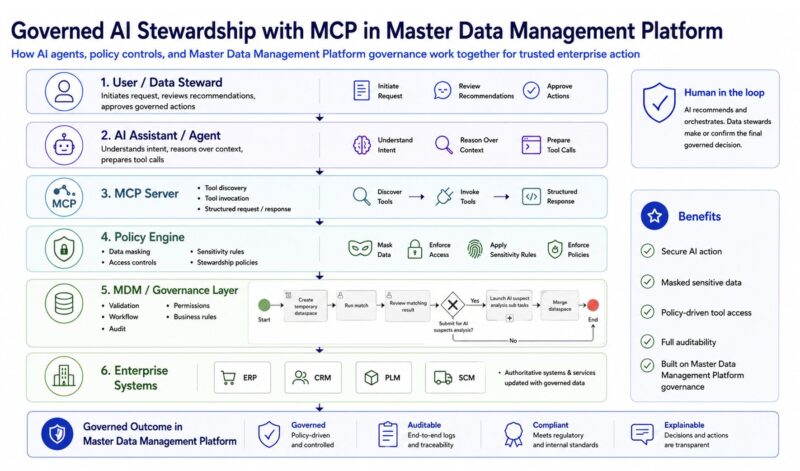
That is why the Model Context Protocol (MCP) has become relevant to data management. MCP gives AI applications a more standard way to connect to tools, systems, data sources, and workflows. Instead of every AI integration being a custom, brittle connector, the agent can discover what tools are available, understand the inputs they require, and invoke them through a structured interface.
Data management teams should care about MCP because it moves AI closer to operational systems. MDM platforms, metadata catalogs, data quality services, reference data systems, lineage tools, and workflow engines all expose capabilities that agents will eventually want to use. The upside is real: faster stewardship, better triage, more consistent recommendations, and less time spent on repetitive exception handling.
The downside is just as real. If an agent can call a data update tool, a vague tool description, an over-permissive role, a prompt injection, or a misunderstood instruction can create operational damage. The lesson is simple: Enterprise AI needs a governance architecture, not just a connector architecture.
MCP creates a well-defined surface area where privacy-preserving controls can be consistently applied. That is why MCP and data masking are complementary: MCP defines where to connect, and data masking defines what the connection is allowed to see.
The Stewardship Gap: Tools Are Not Governance
A common trap is to treat MCP itself as the governance layer. It is not. MCP is better understood as a connectivity and orchestration pattern. The actual governance has to come from the systems, policies, and workflows that surround those tools.
Consider a supplier stewardship example. A user asks an assistant to find suppliers that have not been reviewed in the last 12 months. With proper access controls, that is mostly a read-oriented task: Discover the supplier domain, query the records, and summarize the candidates.
Now change the instruction slightly: Update the supplier risk classification and route exceptions for approval. That is no longer a search task. It is a governed transaction. The agent should prepare a proposed change, invoke an approved tool, apply policy checks, trigger workflow where needed, and preserve an audit trail.
The gap between those two scenarios is where governance lives and where data masking plays an architectural role by ensuring that even in the read case, only the data necessary for the task is exposed to the model.
The AI Access Gap
Most enterprises have already solved the foundational problems of enterprise computing. Identity management, network security, and API access governance are mature disciplines with established tooling and processes.
What remains largely unsolved is how AI agents can interact with sensitive production data without exposing unnecessary personal, financial, or regulated information. This is the AI access gap.
| Capability | Status | Approach |
| Identity and access management | Solved | Mature enterprise IAM frameworks |
| Network security | Solved | Zero trust, perimeter controls |
| API access governance | Solved | API gateways, rate limiting, auth |
| AI access to sensitive production data | Unsolved | Dynamic masking, tokenization, minimization |
Closing the AI access gap requires four capabilities applied dynamically at the data access layer:
- Dynamic masking: sensitive field values replaced with realistic, format-preserving alternatives based on task context and role
- Tokenization: exact values replaced with consistent tokens that preserve referential integrity without exposing underlying data
- Data minimization: only the fields required for the task are exposed; all others are withheld or generalized
- Synthetic replacement: in non-production and AI development environments, realistic synthetic data replaces real sensitive values entirely
Data masking provides these capabilities at the data layer, outside the AI model, ensuring that the same controls apply consistently across agents, applications, development environments, analytics pipelines, and AI/ML workflows.
Data masking closes the AI access gap: It lets organizations provide enough data for intelligence while exposing only the data necessary for the task.
A Reference Architecture for Governed AI Stewardship
A practical governed-AI pattern has six layers, each with a specific role in ensuring that AI agents operate with both capability and control.
Layer 1: Human Stewardship
The user or data steward initiates the request, reviews the recommendation, and approves the governed action. Human-in-the-loop is built into the transaction path for high-impact decisions, not offered as an optional override.
Layer 2: AI Assistant
The AI assistant interprets intent, reasons over available context, and prepares a tool call. It should not require direct database credentials, unrestricted access to sensitive data, or the ability to act without a policy check.
Layer 3: MCP Server
The MCP server exposes approved tools: metadata discovery, schema lookup, record retrieval, duplicate analysis, workflow launch, inbox retrieval, and controlled record updates. Tool descriptions are operational controls, not documentation.
Layer 4: Privacy-Preserving Policy Layer (Data Masking)
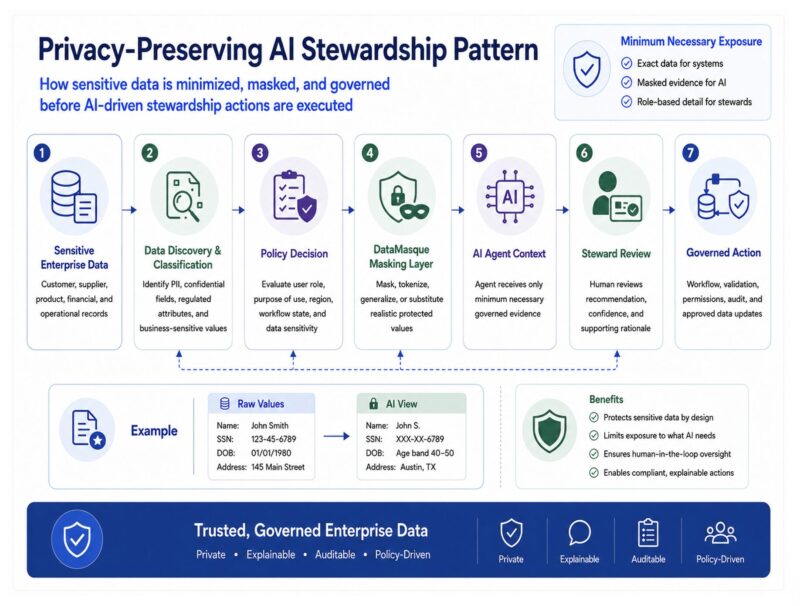
This is the critical layer that determines what data the AI agent actually sees. Data masking enforces masking, tokenization, generalization, and data minimization before information is exposed to AI agents or downstream workflows. The policy layer evaluates:
- Who is asking: user role, clearance level, and purpose of use
- What task is being performed: read, write, match, merge, or approval
- Which data category is involved: PII, financial, health, or reference data
- What regulatory region applies: GDPR, CCPA, HIPAA, or other frameworks
- Whether the agent needs exact values or usable equivalents
Static redaction is too crude. Unmasked exposure is too risky. Dynamic, context-aware data masking is the architectural pattern that makes both unnecessary.
Layer 5: MDM and Governance Platform
The MDM or governance platform executes the transaction using its native controls: validation, permissions, workflow, survivorship, versioning, and audit. AI accelerates the process, but the governed data platform remains the control plane.
Layer 6: Downstream Systems
ERP, CRM, PLM, and SCM systems consume the approved outcome. The action becomes operational only after the governance layer has done its job.
How Governed MDM Platforms Operationalize This Pattern
The reference architecture becomes much more practical when the MDM platform is not just a passive data store, but an active governance execution layer.
In a governed MDM environment, the agent does not write directly to operational tables. It interacts with approved tools, and those tools execute through the platform’s native governance controls: data model constraints, permissions, workflow, validation, versioning, audit, and controlled publication to downstream systems.
This distinction matters. AI should not become a shortcut around data governance. It should become a faster way to participate in governance.
For example, in a mature MDM platform, a proposed AI-generated update can be staged in an isolated working context, validated against the data model, routed through a stewardship workflow, reviewed by a human steward, audited, and only then published to downstream systems. That pattern allows AI agents to assist with operational data work without bypassing the controls that make enterprise data trustworthy.
Governed MDM Capabilities Required for Agentic AI
| Governed MDM Capability | Why It Matters for Agentic AI |
| Model-driven governance | Agents need to understand data structure, relationships, constraints, and business meaning before recommending or initiating action. |
| Isolated work areas | AI-proposed changes should be staged and reviewed before they affect trusted operational data. |
| Workflow-driven approval | High-impact actions need human review, routing, escalation, exception handling, and approval. |
| Native validation and constraints | AI recommendations must be checked against business rules before execution. |
| Role-based and record-level security | AI access must respect the same entitlements as business users and stewards. |
| Audit and history | Every AI-assisted read, recommendation, approval, and update should be traceable. |
| Metadata and privacy context | Agents need context about sensitive data, business terms, ownership, lineage, and intended use. |
| Governed services and APIs | AI agents need controlled integration surfaces, not direct database-level access. |
Data Masking: The Missing Ingredient in Many AI Agent Designs
Data masking becomes especially important when AI agents need to operate on sensitive enterprise data. The pattern below shows how sensitive data can be discovered, classified, masked, minimized, and governed before it is exposed to an AI agent or used in downstream stewardship workflows.
AI Stewardship for Customer Master Data
To make this architecture concrete, consider a customer master data scenario that only privacy-preserving controls can fully solve.
An AI stewardship agent is helping resolve potential duplicate customer records. The task requires enough information to make a meaningful comparison but not every raw value in the customer record.
| Data Field | Agent Needs This? | Data Masking Output |
| Age band | Yes — needed for segmentation | 35–44 |
| Region | Yes — needed for routing | Pacific Northwest |
| Customer segment | Yes — needed for classification | Enterprise |
| Match confidence score | Yes — needed for stewardship | 0.94 |
| Full SSN | No | Masked: 987-56-1234 |
| Exact date of birth | No | Masked: retain age |
| Full street address | No | Masked: City / State / ZIP |
| Credit card number | No | Tokenized: synthetic card number |
Data masking dynamically provides usable but protected values that preserve business context while reducing unnecessary exposure. The AI agent receives the information it needs to perform the stewardship task. It does not receive the information that creates regulatory risk or audit exposure.
This is a materially different value proposition from simple redaction. Redaction makes data unusable. Privacy-preserving masking makes data safe without making it useless. That distinction is what enables AI agents to operate on enterprise-grade data at scale.
Optimize Your Data Catalog
Learn how to successfully implement, govern, and drive the adoption of an enterprise data catalog.

Match and Merge as a Concrete Use Case
Match and merge is a useful example because it combines probabilistic judgment, business rules, and human accountability. A matching engine may identify potential duplicate records. An AI assistant can help compare the evidence, summarize similarities and differences, explain why a merge is recommended or rejected, and highlight which attributes require human review.
But the AI should not be the final authority for high-impact merges. Merge decisions affect survivorship, downstream synchronization, reporting, customer experience, supplier management, and compliance. The agent’s role is to accelerate the steward, not replace the governed decision process.
In a governed design, MCP allows the agent to retrieve match context, analyze candidates, store a recommendation, and launch the right review task. The MDM workflow then controls review, approval, exception handling, merge execution, and audit. Sensitive fields are masked or minimized based on task and role.
Data masking makes it possible to configure, enforce, and audit exactly which fields are masked, tokenized, or generalized for each combination of task type, user role, and data category. That configurability makes it a practical architectural component rather than a one-size-fits-all redaction tool.
Privacy-Preserving AI in Non-Production Environments
Before AI agents reach production, they are typically trained, tested, evaluated, and refined in development and staging environments. This creates a risk that is often underestimated.
Many organizations are building AI copilots, AI assistants, RAG systems, and agentic workflows in non-production environments that contain cloned or refreshed production data. Those environments frequently inherit the same privacy risks as production because the underlying data has not been adequately treated.
Non-production AI environments are often more permissive than production, with broader access, weaker monitoring, and less formal governance. When sensitive production data is present in those environments, the exposure risk can be higher, not lower.
Organizations that adopt privacy-preserving controls for AI development environments gain several concrete benefits:
- AI copilots and assistants can be developed and tested without exposing real customer, employee, or financial data.
- RAG systems can be trained and evaluated on realistic but masked data, reducing the risk of models memorizing sensitive values.
- Agentic workflows can be validated against realistic data volumes and distributions without creating compliance exposure.
- Development teams can iterate faster because security and governance reviewers can approve broader data access when masking controls are in place.
Data masking enables organizations to accelerate AI experimentation while reducing the exposure of sensitive information throughout the development lifecycle. Faster development cycles, fewer security review bottlenecks, and lower risk of costly data incidents during AI testing that is the business case for masking in non-production AI environments.
The organizations building AI fastest are not the ones giving developers access to production data. They are the ones giving developers access to production-quality masked data.
Trust Acceleration: Why Masking Unlocks AI Adoption
Most data masking vendors talk about compliance. The strategic framing is different: masking unlocks AI adoption.
The bottleneck in most enterprise AI programs is not technical. Organizations have the infrastructure, the models, and the use cases. What they lack is organizational trust: confidence from security teams, governance teams, privacy teams, and legal teams that AI agents can access sensitive data responsibly.
Privacy-preserving data access, implemented through controls like data masking, changes the conversation with every stakeholder:
- Security teams can approve AI access to sensitive systems because the data exposure surface is defined and controlled.
- Governance teams can approve AI stewardship workflows because what the agent sees is governed by policy, not model behavior.
- Privacy teams can approve AI initiatives because data minimization is enforced at the architectural level, not just stated as a principle.
- Legal teams can approve broader AI experimentation because masked data carries lower regulatory liability.
The cumulative effect is faster AI adoption not faster in spite of privacy controls, but faster because of them. Privacy-preserving architecture is the mechanism that converts executive enthusiasm for AI into operational reality.
Organizations that understand this reframe masking from a compliance cost into an AI enablement investment. The ROI is not measured in avoided fines. It is measured in AI initiatives that move from proof-of-concept to production at enterprise speed.
The Agentic AI Maturity Model
As organizations move from AI assistants to autonomous enterprise agents, the privacy and governance requirements evolve. The following model maps AI capability to risk level and the controls required at each stage.
| Level | AI Capability | Risk | Privacy Control Required | Governance Execution Required |
| Level 1 | AI reads documents | Low | Standard security controls | Content access control |
| Level 2 | AI accesses enterprise systems via APIs | Medium | Role-based access, audit logging | Governed API/tool access |
| Level 3 | AI initiates workflows and actions | High | Policy enforcement, human approval gates | Workflow routing and task management |
| Level 4 | AI performs governed actions on sensitive data | Very High | Dynamic masking, tokenization, data minimization | Validation, permissions, audit, stewardship approval |
| Level 5 | Autonomous enterprise agents at scale | Critical | Privacy-preserving architecture, full stewardship controls | Model-driven MDM, versioning, controlled publication, lineage, and enterprise governance |
At Levels 1 and 2, standard security controls are often sufficient. At Level 3, organizations need policy enforcement and human approval gates. At Levels 4 and 5, dynamic masking, tokenization, and data minimization become architectural requirements, not optional additions.
Most enterprises today are operating between Levels 2 and 3. The organizations that will scale to Levels 4 and 5 are the ones building the privacy-preserving architecture now, before the governance gap becomes a production incident.
MCP enables connectivity. Governance provides accountability. Data masking enables the move up the maturity curve by making each level safe enough to operate.
Principles for Enterprise Adoption
Deny by Default
Agents should receive only explicitly approved tools. Tool access should be role-based, purpose-based, and environment-aware.
Separate Recommendation from Execution
Let the AI explain, compare, classify, and prepare. Require governed workflows for high-risk writes, merges, deletes, and approvals. The value of AI is in the recommendation; the control is in the execution.
Make Masking Policy-Driven, Not Prompt-Driven
Do not hard-code redaction logic into prompts. Sensitive fields should be classified, policy should determine exposure, and the same policy should be reusable across agents, applications, development environments, analytics, and AI/ML pipelines. Data masking provides exactly this kind of reusable, configurable policy layer.
Preserve Auditability
Every tool invocation should be traceable: who requested it, which agent invoked it, which data was accessed, what was masked, what recommendation was produced, who approved it, and what system executed the final change.
Treat Tool Descriptions as Operational Controls
Tool metadata shapes agent behavior. Vague tools create ambiguity and increase the risk of unintended data access. Precise, scoped tools reduce it.
Apply Masking at the Architectural Layer
Masking enforced at the data access layer is consistent, auditable, and independent of model behavior. Masking expressed only as a prompt instruction is fragile, inconsistent, and unauditable.
Conclusion: Privacy-Preserving Architecture Makes Enterprise AI Practical
The future of enterprise AI is not just conversational. It is operational. AI agents will increasingly help manage records, resolve exceptions, prepare approvals, initiate workflows, and coordinate actions across enterprise systems.
Enterprise AI succeeds when organizations can provide enough data for intelligence while exposing only the data necessary for the task. That is not a compliance slogan. It is an architectural design principle.
MCP enables connectivity. Governance provides accountability. Privacy-preserving controls such as data masking make enterprise-scale AI practical by giving security, governance, compliance, and privacy stakeholders the confidence to approve broader AI access because they know what the agent will and will not see.
The organizations that will lead in agentic AI are not the ones that bypass governance in the name of speed. They are the ones that engineer governance to be fast enough for the age of AI.
The path forward is clear: Build the privacy-preserving architecture now. Use MCP to connect AI to enterprise systems. Use data masking to ensure that connection is safe. Use MDM and governance platforms as the execution layer. Recognize that the speed advantage belongs to the organizations that have earned the trust of their governance stakeholders.
MCP enables connectivity. Governance provides accountability. Data masking makes enterprise-scale AI practical. Together, they allow organizations to move from AI assistants to trusted participants in enterprise data operations at the speed that business requires.
References and Further Reading
Model Context Protocol documentation
NIST AI Risk Management Framework
GDPR data minimization principle
HIPAA privacy and security guidance
CCPA/CPRA privacy guidance
General resources on data masking, tokenization, and privacy-enhancing technologies
Data Architecture Intensive
Learn how to design unified, future-ready data architectures that bring together operational, analytical, and AI data – December 1–2, 2026.