The Data Compass is a new TDAN column published quarterly by DATAVERSITY.
Many people understandably hate the idea of governance, believing that it gets in the way of what they need to get done. Governance, they assume, must be some huge bureaucratic process that inhibits their creativity as human beings to solve problems in their own ways. This is quite wrong.
AI, data, and analytics governance, when done well, is about changing our information-related behaviors so that we get better business outcomes. And by governance, you should not infer “big.” Instead, organizations should focus on doing just enough governance to get the business outcomes they need: not too much, and not too little. This needs the right balance of people, process, practice, and technology to address use cases that business leaders really care about. It is not easy. If it were, we would have solved it by now. But it is certainly possible. The focus of this column will be to illustrate the path to the possible.
Every year, organizations tell us they’re getting smarter about AI. Every year, the data underneath that AI tells a more complicated story. Our latest research confirms what many AI, data, and analytics governance professionals have suspected for some time: The gap between AI ambition and data readiness isn’t closing as fast as their organizations believe. If anything, it’s becoming the defining risk for adoption.
Here’s what the numbers reveal, and why they matter for anyone responsible for the data that powers AI.
The Maturity Gap Is Widening, Not Narrowing
Organizations report a significant uptick in self-assessed AI maturity. Leaders feel more confident, more capable, more “ready.” But when we look at data and analytics maturity –the practices, processes, governance, quality, and infrastructure work that actually underpin a reliable AI ecosystem – the picture is far less optimistic. Data and analytics maturity is lagging behind AI maturity, and the distance between the two is growing.
This is the uncomfortable truth at the center of the research: Organizations are racing ahead with AI on data and analytics foundations that haven’t yet caught up.
Maturity Isn’t Evenly Distributed
Self-reported maturity varies dramatically across business functions and industries. There is no single AI journey. Some functions are sprinting. Others are barely walking. That unevenness is itself a governance problem that must be addressed. Without effective oversight and governance, inconsistent AI, data, and analytics maturity could elevate business risk exposure across the enterprise.
But one pattern stands out clearly: Organizations that have already succeeded at BI and data governance are the ones showing the highest AI maturity today. This is not a coincidence. It’s a preview of where every organization is headed. The companies that invested early in clean data, clear accountability and decision rights, and effective governance are the same ones now able to move fastest and most confidently with AI. Governance isn’t a brake on innovation – it’s the on-ramp.
What Enterprises Say Is Actually Standing in the Way
When a Dresner market study asked directly about the barriers to AI adoption, enterprises pointed to a familiar (and telling) list of concerns. Security and privacy have actually moved down the list compared to a year ago, as vendors and internal teams have made progress addressing those issues. That’s a genuine win worth acknowledging.
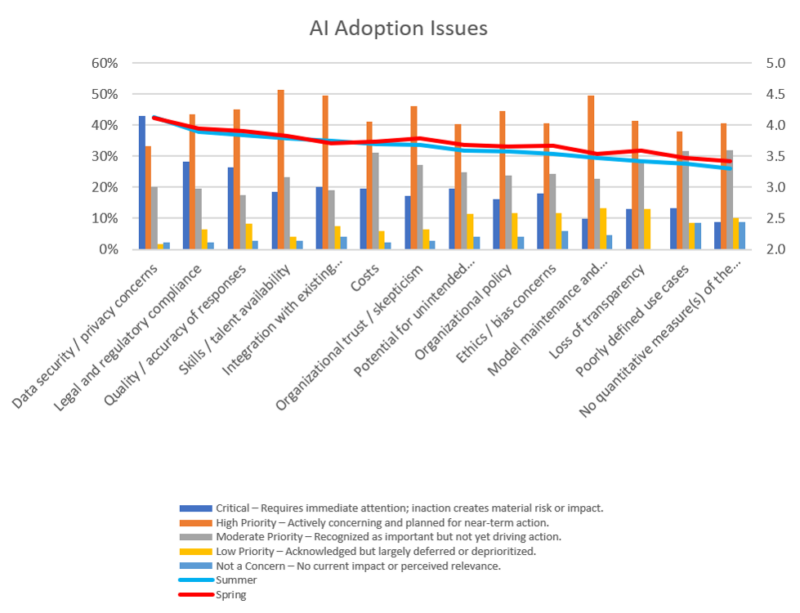
But stepping back from that bright spot, the broader picture reinforces just how business-critical governance has become. The issues enterprises now flag most include:
- Data quality: The perennial, unglamorous problem that never fully goes away
- Digital trust: Whether people inside and outside the organization believe the outputs
- Policies: Whether there are clear rules for how AI can and should be used
- Ethics and bias: Whether outcomes are fair and defensible
- Use cases: Whether the organization actually knows where AI creates value versus where it creates risk exposure
Every one of these is, at its core, a data governance issue wearing an AI costume. If AI is to bring real and sustainable value to organizations, investment is also needed in the governance of the foundations on which it rests.
Data Governance Bootcamp
Learn strategies for planning, designing, and sustaining data governance programs – October 6, 13 & 20, 2026.

Agentic AI Further Raises the Stakes
The above research digs deeper into the hottest area of AI right now: agentic AI. With agentic AI, systems don’t just generate content – they take action. And here, the list of concerns gets more urgent.
What’s most noteworthy isn’t that these concerns exist. It’s that the criticality of security, privacy, and legal and regulatory compliance remains stubbornly high even as organizations push forward. These aren’t fading worries being completely solved by better tooling. They’re persistent, high-stakes issues that agentic AI is amplifying rather than resolving.
Agentic AI also introduces something genuinely new to the governance conversation: the need to audit AI actions. When AI systems can act autonomously – executing transactions, modifying records, triggering workflows – organizations need the ability to trace, verify, and explain what the AI did and why. This is a fundamentally new governance discipline, distinct from managing AI-generated content or predictions.
And right now, the enterprise isn’t ready for it. Dresner research shows that only 16% of organizations say they are very prepared to audit AI actions. That’s not a gap – that’s a chasm, sitting directly beneath one of the fastest-growing categories of AI deployment.
The Business Case Is Now Undeniable
Here’s the good news, and it’s significant: The ROI on AI investment is clear in the research. Organizations are seeing real returns. This isn’t a hypothetical anymore, and it isn’t a hard sell to leadership. The value case for AI has been made: by the market, by the data, by the results.
That’s exactly why this is the moment for AI, data, and analytics governance professionals to act. When ROI is proven but the underlying data and analytics foundations are shaky, the risk isn’t that AI fails to deliver value – it’s that it delivers value unevenly, unsafely, or unaccountably, while exposing the organization to compliance, security, and trust failures along the way.
The business case for data governance no longer needs to be argued in the abstract. It can be tied directly to a business case that leadership already believes in. The pitch is no longer “invest in governance because it’s the right thing to do.” It’s “invest in governance because it’s the only way to sustain the AI returns your organization is already counting on.”
The Takeaway
AI investment is outpacing investment in other information areas. However, the maturity of AI is limited by maturity in precisely those other areas.
If AI maturity is to be sustainable, AI leaders must broaden their governance thinking beyond only AI assets. Security and privacy fears are easing even as data quality, trust, policy, and ethics concerns take center stage. Agentic AI is raising the bar further, introducing an auditability requirement that fewer than one in five organizations feel ready for. And the ROI that once justified caution now justifies investment.
For governance professionals, the message from this research is clear: The window to make the case is open, the evidence is on your side, and the cost of waiting only grows as agentic AI moves from pilot to production.
Build your AI governance skills in 2026.
DATAVERSITY’s training programs cover AI governance, data governance, and compliance for data practitioners.