By Aakriti Agrawal Kim (Lead Author); Tammy Baker (Lead Author); Alexander Borek, Ph.D.; Dora Boussias; Dan Everett; Kimberly Herrington, MS; Danette McGilvray; Michelle Pipes, DBA; Thomas Redman, Ph.D.; Anne Marie Smith, Ph.D.; C. Lwanga Yonke
Why We Started Asking About Fear
This inquiry began after an earlier effort to build bottom-up support for data quality did not go as hoped. In the postmortem, fear was raised as one possible explanation: If not fear, what else might explain why people hesitate to engage, escalate, or act on known data quality concerns?
That question led a group of data quality, data governance, change management, qualitative research, and organizational leadership practitioners to explore how fear may influence communication, accountability, decision-making, and action around data quality. Over time, the discussion expanded to include how fear shows up across roles, how it can motivate or obstruct progress, and why people may avoid surfacing issues even when they care deeply about improving data.
Data quality problems rarely persist for only one reason. Technical limitations, fragmented systems, unclear processes, weak ownership, resource constraints, culture, and ineffective management structures all contribute. Fear does not replace those explanations. Instead, fear may help explain why some of those known problems remain unspoken, unresolved, or worked around rather than addressed.
In many organizations, data quality is still treated primarily as a technical or process problem. Tools, dashboards, controls, lineage, metadata, and governance structures all matter. Yet those capabilities depend on people being willing and encouraged to ask questions, challenge assumptions, report issues, admit uncertainty, and escalate concerns before the cost of correction grows. When people believe that surfacing a data issue may create blame, expose weakness, slow a high-visibility project, damage relationships, or threaten their credibility, silence can become the safer choice.
Data Quality Accelerator
Learn how to build, sustain, and measure a data quality initiative – September 30 – October 1, 2026.

What This Article Represents
This article is not a complete diagnosis or an evidence-based methodology. It is a synthesis of practitioner conversations convened to explore a difficult and often underexamined question: How might fear influence whether data quality issues are surfaced, discussed, escalated, or resolved?
The purpose of this article is to name recurring patterns, clarify language, and invite a more disciplined conversation about the human conditions that shape data quality work. It is written for data quality leaders, data governance leaders, data stewards, data executives, and change leaders who have seen data issues persist despite investments in tools, processes, controls, and governance forums.
The group ultimately aligned on this problem statement:
“Poor data quality negatively affects our world. Fear influences behavior but is often unexamined. When people lack the language and tools to recognize how fear shapes decisions, communication, and actions around data, data quality initiatives struggle to achieve their intended outcomes.”
This article begins with that foundational challenge. Before organizations can decide what to do about fear, they need a clearer way to recognize where it may be shaping behavior. What is unnamed is easily misdiagnosed. Silence may be mistaken for agreement. Avoidance may be interpreted as resistance. Delayed escalation may be treated as a process failure alone. Naming fear does not solve the problem, but it can point leaders in a direction to ask better questions about why data quality problems persist, what conditions may need to change, and if fear is part of what is holding them back.
How Organizational Conditions Shape Data Quality Behavior
Data quality is often approached solely as a technical discipline. Organizations invest in data platforms, controls, lineage tooling, metadata management, observability solutions, and dashboards intended to improve accuracy, consistency, completeness, and trust. These investments matter. However, technical controls alone do not determine whether data quality problems are identified, escalated, discussed honestly, or addressed sustainably.
Data quality improvement often requires changes in how people are supported, what is expected of them, how they are rewarded, and how they are enabled to work with data. Those changes can create uncertainty. Uncertainty often triggers fears, incentives, and protective behaviors that influence how people respond to quality improvement efforts. At its core, data quality depends on human behavior. People decide whether to question suspicious metrics, escalate concerns, or rely on temporary workarounds. Even highly automated environments still rely on people to interpret signals and act on what the data reveals.
The human dimension of data quality does not stop with individual choices; it extends to the organizational conditions that shape them. Communication patterns, incentives, hierarchy, leadership responses, project pressures, and cultural norms all shape how data issues are handled. Where transparency is rewarded, concerns surface earlier and are resolved more collaboratively. Where escalation feels risky, the same issues may remain hidden until they become operational, regulatory, or reputational problems.
Many organizations unintentionally frame data quality as a downstream technical problem rather than an upstream behavioral and organizational problem. As a result, remediation efforts often focus on technology, while overlooking the conditions influencing human behavior around the data itself. Yet data quality work routinely requires people to surface uncomfortable truths and sometimes adjust the pace of work to prevent larger failures later.
While data governance and quality discussions often focus on controls, policies, and technology, people’s willingness to speak honestly about data quality concerns often depends on less visible factors: trust, incentives, leadership responses, competing priorities, power dynamics, and perceived consequences.
The discussions also highlighted an important nuance: fear is rarely just an individual characteristic. It is often a signal of the environment people are working within. Organizations may measure compliance, performance, and delivery outcomes yet give little attention to whether people feel safe raising concerns, admitting uncertainty, or reporting difficult truths. Amy Edmondson, acclaimed American scholar, describes psychological safety as the belief that one will not be punished or humiliated for raising concerns, asking questions, admitting uncertainty, or acknowledging mistakes. When that safety is missing, data quality issues are more likely to remain hidden.
Many organizations treat data quality metrics as lagging indicators. Error rates, issue backlogs, and remediation statistics reveal problems that have already surfaced. Psychological safety may function as a leading indicator because it influences whether emerging concerns are identified early enough to be addressed. Organizations cannot manage or govern what they never learn about. Management and governance structures can define what should happen, but they do not guarantee that people will surface concerns, disclose uncertainty, challenge assumptions, or engage honestly when problems emerge. Ownership models answer the question of who is responsible. Organizational culture and conditions determine whether information reaches those owners quickly enough to matter.
What Fear Looks Like in Data Work
In this inquiry, fear is not treated as a character flaw. It is a human response to perceived threat, uncertainty, or negative consequences. In data work, fear may signal that people are trying to protect credibility, professional standing, control, reputation, job security, or trust. The threat may be personal or professional, immediate or future-facing.
Fear is often easier to recognize through behavior than language. Many data professionals may not describe themselves as fearful, but they recognize hesitation, avoidance, overcautiousness, or reluctance to act. Leaders and managers may observe these same behaviors without naming them as fear. When fear remains unnamed, organizations may treat the symptoms rather than the conditions producing them.
What looks like resistance to change may sometimes be fear, especially when people are unsure what the change will mean for them. Will they be blamed? Will they lose control?
Workplace fears often stem from perceived consequences. Fear of consequences can make professionals reluctant to identify poor data quality, especially in environments where mistakes or weaknesses are punished rather than addressed constructively. Participants described common internal calculations: “If I surface a problem, I’m creating work for myself,” or “I may be exposing a flaw in my team.”
Not all fear stems from anticipated consequences. Rapid technological change, organizational transformation, and evolving expectations can create uncertainty about roles, skills, and future opportunities. In these environments, hesitation may reflect uncertainty more than unwillingness.
Perceived risks vary by role, authority, accountability, and proximity to the issue. Although the triggers vary, the behavioral consequences are often similar.
Fear is not always negative. Sometimes it sharpens focus and creates urgency. Other times, it suppresses the truth data quality work depends on.
Developing a Data Quality Program
Learn how to navigate critical components of designing and launching a data quality program with precision.

When Fear Helps and When It Obstructs
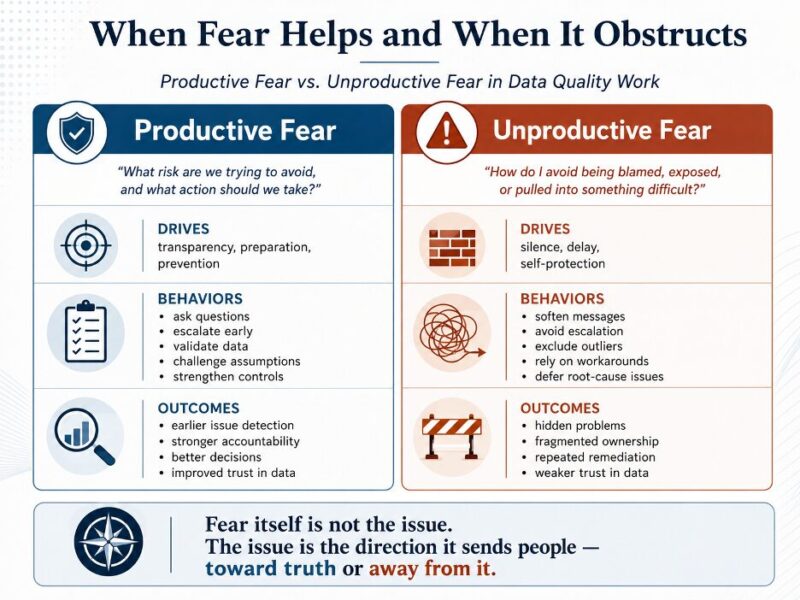
The group debated whether fear primarily motivates better behavior or suppresses it, eventually concluding that fear can do both. Several challenged the assumption that fear is inherently negative: one observed that “fear is a motivator,” while another argued that people often change when “the pain of fear is lower than the pain of where you are.” The difference is not the emotion itself, but the direction it sends people.
Productive fear moves people toward transparency, preparation, and prevention. It asks, “What risk are we trying to avoid, and what action should we take?” Unproductive fear moves people toward silence, delay, and self-protection. It asks, “How do I avoid being blamed, exposed, or pulled into something difficult?”
Productive fear can motivate stronger data quality behaviors, especially when the stakes are high: regulatory compliance, reputational risk, excessive cost or waste, loss of market share, safety, or trust. A fear of patient harm can motivate stronger clinical and safety data practices. A fear of regulatory findings can motivate stronger data controls. A fear of executive decisions based on flawed data can motivate better definitions, validation, and quality checks.
Unproductive fear replaces transparency and useful problem-solving with silence, superficial compliance, delay, softened messages, avoided metrics, excluded outliers, or public agreement paired with private concern.
It may sound like, “We can fix that later,” “Don’t slow the project down,” “That is outside our scope,” or “Let’s not open that up right now.” In those situations, the data quality issue may be known, but not owned, visible but not escalated, worked around but not resolved.
In our discussions, we frequently distinguished between urgency, which can focus action, and panic, which can impair judgment and suppress communication.
Where Fear Shows Up in Organizations
Fear does not appear uniformly across an organization. Different roles experience different pressures, incentives, and consequences depending on their authority, accountability, visibility, and proximity to operational risk.
Executives may fear reputational damage, regulatory findings, public scrutiny, or strategic decisions based on inaccurate information. Because they are accountable for outcomes, visible initiatives can create pressure to reward optimism over transparency. If success is defined as not having problems, no one will ever raise a problem.
Middle managers often operate between strategic expectations and operational realities. They may fear being seen as blockers, slowing delivery, increasing scope, or creating additional work for constrained teams. When speed, stability, and quality compete, unresolved issues may become tolerated workarounds because root-cause remediation feels disruptive or unrealistic. Yet teams bear the costs of those workarounds, which often remain invisible to management.
Data stewards and governance practitioners may experience accountability without authority. They are often responsible for identifying, documenting, escalating, or coordinating remediation without direct control over the systems, funding, delivery teams, or business processes required to resolve the issue. Stewards may hesitate to escalate concerns if previous issues were ignored, minimized, or interpreted as criticism of other teams. One member of the group described a common challenge facing change leaders: success often depends less on providing additional knowledge and more on helping people develop the courage to act on what they already know.
Analysts, engineers, and project teams may fear slowing momentum on high-visibility initiatives. Raising data concerns can feel risky when projects have committed timelines, executive attention, or promised business outcomes. Team members may fear being perceived as overly cautious, difficult, or resistant to change. Issues may be deferred not because the risks are acceptable, but because the organization seems unwilling to absorb the impact of addressing them properly. Participants noted that fear often manifests through silence rather than overt resistance. Concerns may remain unspoken because people are uncertain how they will be received or fear negative consequences. In these situations, the absence of escalation can be mistaken for agreement.
Organizations often receive exactly the behaviors they reward. Although many organizations promote openness and accountability, operational realities may reward speed, certainty, and uninterrupted delivery. Over time, people adapt to the system they experience rather than the one described in governance documents.
In many environments, fear becomes embedded in everyday habits and operational norms. Recognizing where fear appears, and how it differs across organizational roles, helps explain why data quality problems persist even in organizations with well-established governance structures and strong technical capabilities.
Behavioral Signals of Fear
Fear is often visible before it is verbalized. People may not say, “I am afraid to raise this issue,” but the signs appear in how data problems are handled—or avoided entirely—through buried issues, softened metrics, avoided questions, and normalized workarounds.
Common signals include:
People stop asking questions. When fear exists, people may choose silence over curiosity. They become apprehensive about speaking up, asking questions, or sharing information. The irony is, the less people speak up, the worse the data gets. Over time, curiosity is replaced by caution, which is especially damaging in data quality work, where improvement depends on questioning assumptions, challenging definitions, and exploring uncertainty.
Data gets filtered before it is shared. Outliers may be excluded. Edge cases may not be logged. Risky metrics may stop being measured.
Responsibility exceeds authority. People may hesitate to raise data quality concerns when they are accountable for outcomes but lack authority over the systems, processes, or decisions causing the issue. This is especially true when those closest to the problem have the least power to address it. This imbalance creates predictable friction. Individuals who are expected to identify and coordinate remediation may conclude that escalation carries personal risk without increasing their ability to influence the outcome. Over time, participation declines and known problems become tolerated workarounds.
Known problems become workarounds. Teams may implement quick fixes or workarounds instead of escalating root-cause issues. From a distance, everything may appear to be working, but only because people are manually correcting, reconciling, or routing around known data quality problems.
People avoid “disrupting the hamster wheel.” In high-stakes projects, fear can prevent people from surfacing data quality issues because the project already has a hard deadline, committed benefits, executive attention, or board-level visibility. Without a clear escalation path, issues may not be reported at all.
Data quality is seen as slowing things down. Project leaders or sponsors may resist governance and data quality activities when they are perceived as slowing delivery, overcomplicating execution, or diverting resources from other priorities. When raising concern is seen as slowing progress, people may conclude that remaining silent is safer.
What Is Unnamed Cannot Be Managed
Recognizing these behavioral signals is only a first step. Organizations also need language that allows people to discuss what may be producing them.
Data quality improvement often begins with technical questions: What system is the source of truth? What rules should be applied? What tools, controls, dashboards, or workflows need to be improved? These questions matter. But there will be situations where data quality improvement may need to begin one layer earlier – with behavioral visibility. Before organizations can fix data, they need to understand whether people are raising issues, asking questions, escalating risks early, or waiting until the project is too far along to change course.
Many of us argued that fear remains difficult to address because many organizations lack the language for discussing it. One contributor emphasized the need to “name fear so that people can connect to it,” while another noted that organizations first need to “help people define what fearful means so they can recognize and address it.” Without a shared language, organizations may confuse fear with resistance, disengagement, caution, or lack of skill.
When fear is not named, organizations often misunderstand the problem. Silence may be interpreted as agreement, avoidance as disengagement, delayed escalation as weak process discipline, and poor data quality as a tooling or training gap. Those explanations may be partly true, but incomplete. A data catalog, dashboard, or stewardship model will not reach the root cause if people do not feel safe asking hard questions, acting on what the data reveals, or escalating issues they cannot resolve on their own.
If the real issue is fear of blame, lost credibility, or slowing a high-visibility project, the answer is not simply more training or a better workflow. Naming fear is not about removing accountability; it is about making accountability possible.
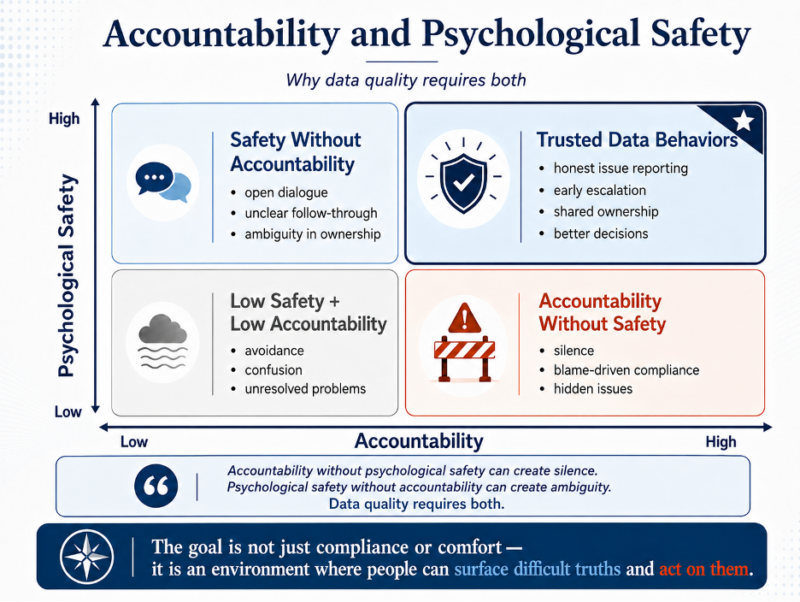
The group agreed that accountability alone cannot improve data quality if people do not feel safe speaking up. Psychological safety creates conditions that allow information to flow before problems become crises. Accountability without psychological safety can create silence. Psychological safety without accountability can create ambiguity. Data quality requires both.
Recognizing fear as a behavioral signal helps leaders ask better questions: What feels unsafe to say? Where does accountability exceed authority? What issues are people managing around instead of surfacing?
Fear becomes damaging when it causes people to hide, delay, soften, or avoid the truth. Organizations therefore need conditions in which acting with courage is expected, supported, and rewarded.
Why These Patterns Matter for Data Quality
When fear shapes behavior around data, the effects are rarely isolated to a single issue, report, or project. Data quality signals may surface late, be absorbed into workarounds, or grow into larger operational problems. These risks become even more consequential as organizations increasingly rely on automation and artificial intelligence. Poor-quality data can propagate through automated systems rapidly, amplifying the scale and speed of downstream impacts. In these environments, the willingness of people to question assumptions, challenge outputs, and communicate uncertainty becomes even more important. Fear can suppress exactly the kind of questioning that responsible AI governance depends upon.
Over time, these behaviors can erode trust in reporting, fragment ownership, weaken accountability, and widen the gap between organizational perception and operational reality.
Many organizations experience the downstream effects of fear without recognizing the behavioral patterns behind them. Repeated remediation cycles, unresolved root causes, inconsistent reporting, governance fatigue, and low trust in data are often treated as isolated technical failures. In practice, they may also reflect environments where honesty feels risky, escalation feels costly, or transparency feels professionally unsafe.
Some data quality failures are social failures before they become technical failures. Governance structures and tools cannot fully compensate for environments in which honesty feels risky, uncertainty must be hidden, or difficult conversations are avoided. Trusted data depends not only on technology, but also on the conditions organizations create for people to engage with data – and with each other – honestly.
The group repeatedly returned to a common theme: data quality work requires courage. It requires people to ask uncomfortable questions, challenge assumptions, disclose uncertainty, and surface inconvenient truths. These actions are often fear-motivated. The issue is not whether fear exists, but whether it moves people toward transparency and learning or toward silence and self-protection.
A Conversation Starter
Our aim in this article is to put fear front and center, such that people, individual contributors and managers alike, can start the conversations needed to address it. This section provides several questions to help do so.
All well-intentioned managers are horrified to find that those who report to them are afraid to speak up. Similarly, most truly appreciate those who come to them with a clearly articulated problem and direction for a solution.
Individual contributors should ask themselves and their peers if their fear is rational and productive. They should ensure that they are able to approach their management or someone else in their leadership, possibly even considering whether speaking up in a group of their peers may be beneficial. Finally, while the risk of speaking up is usually obvious, the risk of not doing so is often left unexamined, so ensure that you have evaluated the risks of not speaking up.
To be clear, we do not recommend putting your job at (greater) risk. Indeed, we have enormous empathy for those who find themselves in fear-laden situations with no apparent way out.
For managers caught in the middle, getting the conversation started is both more difficult, and more important. We believe that managers should not let unproductive fear fester among their teams. Therefore, in addition to the questions above, managers should ask themselves who on their team is fearful, and whether that fear is productive. If it’s not a productive fear, managers should consider how they may be able to ease the fear, or at the very least, acknowledge it, and then further: how they may channel their employee’s fear into constructive action.
Applied Data Governance Practitioner Certification
Validate your expertise and take your career to the next level.

About the Contributors
This article was born out of a series of practitioner discussions on fear and data quality. The conversations brought together professionals from data quality, data governance, change management, organizational leadership, research, and consulting to explore how fear may influence communication, escalation, accountability, and action around data quality.
We were energized by the collaboration, openness, and shared learning that shaped our lively discussions.
Aakriti Agrawal Kim (Lead Author and Discussion Group Facilitator)
Aakriti Agrawal Kim, MBA, CDMP, ADGP, leads large-scale data transformation and governance initiatives at Fortune 100 companies. A published author, she recently released the book Data Governance Change Management, which introduces the ANCHOR Framework for Change Leadership. Aakriti is also a serial nonprofit founder and serves on several nonprofit boards, including those of DAMA Phoenix and DAMA International. Aakriti is passionate about advancing the fields of data governance, change management, and equity in STEM.
Tammy Baker (Lead Author and Discussion Group Facilitator)
Tammy Baker is a data strategy and governance advisor with cross-industry experience designing governance operating models, improving data quality, and guiding cultural change to strengthen trust in data. She holds CDMP, PMP, and ADQ credentials and co-leads the Fear study group focused on data quality and organizational culture.
Alexander Borek, Ph.D.
Dr. Alexander Borek is an AI transformation coach. As CEO at datamasterclass.com, he runs a global community of leaders that are accelerating their journey towards agentic AI. He managed transformations as leader at Volkswagen, Zalando and as strategy consultant at Gartner and IBM.
Dora Boussias
Dora Boussias helps leaders navigate AI-driven change with clarity and confidence. She brings 30 years of real-world leadership experience at the intersection of enterprise data, AI, and transformation. She is the creator of SOAR with Confidence®, a leadership and career acceleration framework designed to strengthen judgment, confidence, and decision-making amid AI-driven change. Her work has been recognized across the industry, including AI100 Innovation Leader and Global Data Power Woman, featured on the CIO Review Magazine cover and in New York City’s Times Square.
Dan Everett
Dan Everett is a technology strategist and advisor with more than 25 years of experience helping organizations turn data and analytics capabilities into reliable business outcomes. His work brings together technical expertise, business strategy, and behavioral psychology to help leaders build trust and get teams aligned around data and AI initiatives.
Kimberly Herrington, MS
Kimberly Herrington is a leading industry researcher covering topics of data literacy, humans-in-the-loop (HITL), data leadership, organizational structure and culture, within a globally recognized research firm serving Fortune 500 organizations. Kim helps C-suite executives drive data-driven decision-making and navigate AI adoption and curiosity with trust and rigor. She is a nationally recognized and award- winning data, analytics and& AI influencer, data literacy advocate, and community builder. She is the creator of Buffalo Business Intelligence, Buffalo’s first BI workgroup. She gives back to her community through advocacy and advisory board participation.
Danette McGilvray
Danette McGilvray is president and principal of Granite Falls Consulting, Inc., a firm that helps organizations increase their success by addressing the data quality and governance aspects of their business efforts. She is the creator of the Ten Steps to Quality Data methodology, one of the first data-related methodologies to clearly incorporate the people-related aspects of data quality work. She is the author of Executing Data Quality Projects: Ten Steps to Quality Data and Trusted Information, 2nd Ed., which is also available in Chinese and Japanese, with the Spanish translation underway.
Michelle Pipes, DBA
Dr. Michelle Pipes, DBA, is an organizational development strategist, change management expert, and creator of the Joyful Change® framework. With more than two decades of experience in organizational transformation, executive communication, and human-centered change strategy, she specializes in helping leaders design change that humans can sustainably carry. Dr. Pipes is Prosci/ADKAR-certified and has advised organizations across industries on culture, adoption, leadership communication, and large-scale transformation initiatives. Her work focuses on the intersection of behavioral science, organizational effectiveness, and the lived human experience of change.
Thomas Redman, Ph.D.
Thomas C. Redman, “The Data Doc,” is the founder and President of Data Quality Solutions. He helps companies attack data issues head-on, get the basics right, and empower people. Everything, from AI, to better decisions and smooth operations, depends on high-quality data. His work can be found in Harvard Business Review, Sloan Management Review and in his latest book, People and Data: Uniting to Transform Your Organization (Kogan Page, 2023).
Anne Marie Smith, Ph.D.
Anne Marie Smith is a leading consultant and educator in data and information management with broad experience across industries. She is a frequent speaker and an author on data management, data governance, data quality, and related topics for a wide range of publications. She has taught numerous workshops and courses in her areas of expertise. Anne Marie holds the degrees of Bachelor of Arts and Master of Business Administration in Management Information Systems. She earned a Ph.D. in MIS, and has earned various industry certifications and fellowships.
C. Lwanga Yonke
C. Lwanga Yonke is a management consultant focusing on data quality, data governance, and unified governance for structured and unstructured data. He leverages 30-plus years of experience in various business, data, and IT roles.