Overview
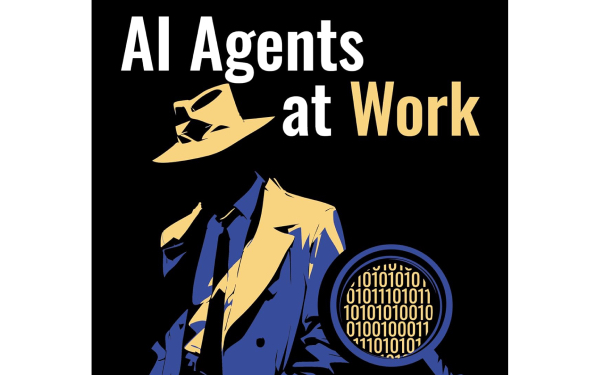
The first book of the month for 2026 is “AI Agents at Work” by Scott Burk, Kinshuk Dutta, and Harman Kaur. As we walk into the technological morass of AI agents in 2026, this is a good time to grab this new entry off the shelf. Let’s dive right in.
The first thing to note about this book is that it’s fairly technical. The authors do an excellent job of educating the reader along, but should one get distracted by specific tools and architectures, it can be tough to follow. “AI Agents at Work,” however, gifts the reader with a fantastic bedrock of knowledge for implementing AI agents, completely demystifying architecture, agent types, and tools that enable multi-agent solutions. If you’re an IT director who has been tasked with supporting AI at your organization, this book is a must.
The first chapter of the book dives into agentic architecture and guides the reader through what ROI and readiness will look like. “AI Agents at Work” also provides a reminder here that AI governance is critical to managing risk. Here is where the reader will discover a nice delivery choice by the authors. The book provides case studies in every chapter, showing the reader a real-world scenario where AI Agents have been deployed. This is further followed by key takeaways and exercises or thought-provoking questions for the reader to ponder. This gives the reader a chance to absorb the content they just reviewed. In the context of the first chapter, this is especially nice because giving the reader a moment to pause and reflect on ROI, readiness, and managing risk with governance is critical to successful deployment of AI agents. This helps the reader avoid pitfalls that have classically caused AI pilot projects to fail in 2025, leading to alarming statistics like “95% of all AI implementations fail.”
The book also really promotes multi-agent systems (MAS), and spends several chapters on how these types of solutions can come to pass. In chapter six, the book specifically gets into orchestration. All throughout this tome, the reader will notice how completely the authors explain what could be difficult concepts. This section is no different: Here we are taught about directed acyclic graphs (DAGs) as a way of showing workflow and handoff between different agents as part of a multi-agent system. The clarity with how this is presented really gives the reader a lot of insight into how these types of solutions can be planned and implemented in the real world, all while continuing to show real-life success with case studies.
Lastly, the book shows how the world was changing even at the time the authors were putting everything together, showing how strides in Microsoft’s Copilot and Glean’s agent builder are impacting the ability for organizations to realize efficiencies by implementing AI agents in their organizations.
In conclusion, this book is recommended reading for IT folks who have been tasked with enabling AI at their organizations. The level of detail it gives around understanding risk and building an architecture that supports actual use cases in various verticals is invaluable. Guiding the reader through the book with discussion questions/exercises (as prompted at the end of every chapter) gives a great structured understanding of what needs to happen each step of the way.
About the Book Authors
Dr. Scott Burk is the founder of “It’s All Analytics.” He is the author of eight books on AI, data science, and analytics, including the It’s All Analytics Series. He currently teaches in the MS in Data Science program at CUNY and has taught and developed curriculum at Baylor, Texas A&M, and SMU. He has solved complex AI, statistical, and analytical problems at Dell, Texas Instruments, PayPal, eBay, Overstock.com, healthcare organizations, energy firms, semiconductor and manufacturing companies, startups, and many others worldwide. Scott holds a BS in biology and chemistry, MS degrees in finance, statistics, and data mining, and a Ph.D. in statistics. Data has been the unifying thread across his professional experience.
Kinshuk Dutta is a technology leader with nearly two decades of experience driving innovation in data, integration, and cyber security. He is the co-author of the recent best-selling “Data for AI,” founder of Be Cognizant of Data (datanizant.com) where he advocates for responsible data practices and AI enablement, a named inventor on AI patent. Kinshuk is a Senior Member of IEEE, recognized for shaping the future of intelligent systems and guiding organization through AI-driven transformation.
Harman Kaur is an R&D leader focused on AI and automation with nearly a decade of cybersecurity experience and is a named inventor on multiple AI patents. She is a cyberspace operations officer in the United States Air Force with 13 years of service across Active Duty and Reserve component. Harman holds an MBA from the University of Southern California.
DMBOK and CDMP Prep: Data Management Fundamentals
Gain a comprehensive foundation to prepare for your CDMP certification.