The Good AI is a TDAN column published every quarter on DATAVERSITY.
AI is changing the economics of data delivery. Organizations should use that change to build stronger data foundations while demonstrating value much sooner.
The Cycle We Keep Repeating
For years, organizations have described data as a strategic asset, yet many still struggle to sustain investment in the foundation required to make it trustworthy and useful. The challenge is timing. A proper data platform takes time to build, and its value compounds over time, while a workaround can produce an answer immediately. One workaround becomes several, definitions diverge, ownership becomes unclear, and teams eventually spend more time reconciling data than using it.
Investment usually follows a crisis: an audit issue, a regulatory requirement, an unexpected number in front of leadership, or a strategic initiative that cannot move because the underlying data cannot be trusted. The urgency gets funding approved and foundational work underway, but when value takes longer to materialize than the business expects, attention and funding move elsewhere, and the cycle starts again.
AI is changing those expectations. Code, documentation, testing, and portions of data engineering can now be accelerated significantly. Business users can see answers generated in seconds, making a traditional data investment that promises value years later increasingly difficult to justify.
The opportunity is to change the economics of the foundation itself. Rather than treating data capability as a large prerequisite that must be funded before value appears, organizations can build it through a series of small, business-owned outcomes, using AI to accelerate delivery, validation, and governance while keeping accountable people responsible for meaning, risk, and decisions.
That is the approach I am recommending to organizations today. It rests on six connected practices spanning business ownership, priorities, value, technology, architecture, and governance. Across all six, the guiding principle should be to use AI wherever it can remove friction and accelerate execution, while deliberately keeping human accountability where context and judgment matter.
Six Practices for Keeping the Data Investment Moving
1. Turn stewardship from a bottleneck into an accelerator.
Clear business ownership has always been important, but simply assigning sponsors and stewards does not solve one of the most persistent problems in data delivery: the people who need to make decisions are often the same people who have the least capacity to support the process.
This is where AI changes the model. Instead of asking stewards to assemble definitions, document rules, populate catalogs, and chase down context, leverage AI to prepare much of that material from information the organization already has across documentation, metadata, existing datasets, and prior decisions, and to identify gaps, track outstanding decisions, and bring the relevant context to the person who needs to approve it.
The steward still decides what a business term means, whether data is fit for a particular purpose, and who owns it. The difference is that the steward starts with a well-prepared rather than a blank page. That distinction can materially reduce one of the most common sources of delay while preserving human accountability.
2. Build a ranked portfolio, with AI helping determine where to start.
Instead of beginning with a large platform roadmap, identify a portfolio of smaller business use cases and assess them against value, risk, effort, data readiness, and potential for reuse. The important shift is that AI can help create the initial assessment rather than requiring a team to spend weeks assembling one manually.
Leverage AI to draft a value and effort matrix from available information, identify common data dependencies, and highlight opportunities where one investment could support several future use cases. Technology teams can validate effort and readiness, while sponsors and stewards calibrate the priorities based on business context.
Each selected use case should have a concise charter covering the decision it supports, expected value, required data and definitions, acceptance criteria, and the business process that will change. Sequencing should also consider reuse. If several use cases depend on the same customer, financial or operational data, the investment made for the first should reduce the cost and time required for the next.
The result is a portfolio that becomes more valuable with every release. AI can then help continuously reassess the portfolio as evidence accumulates, while business leaders retain control over which outcomes matter and why.
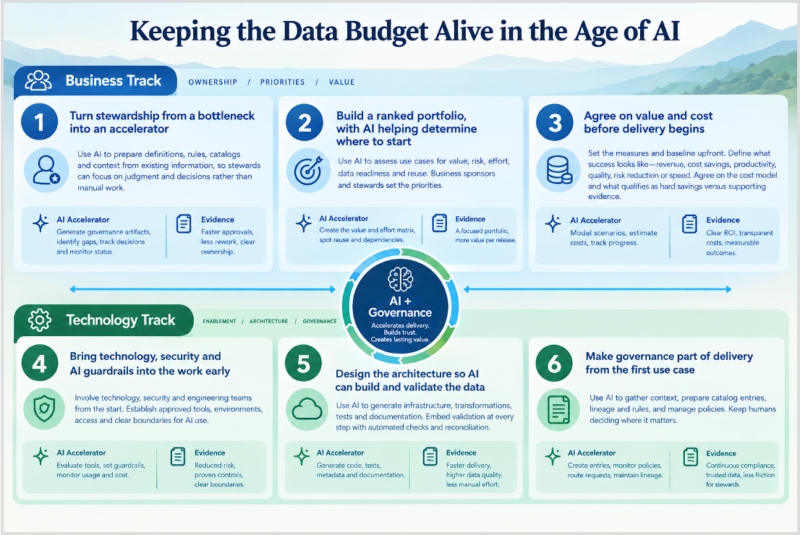
3. Agree on value and cost before delivery begins.
ROI conversations become difficult when value is defined after the work is complete. Sponsors and finance should agree upfront on the measures that will demonstrate value and establish a baseline before development starts. Depending on the use case, this could include revenue, cost savings, productivity, quality, risk reduction, or speed.
The measures should be specific enough to track. Productivity might be measured through hours saved or time to answer a business question. Quality might include errors identified before release or rework avoided. Delivery speed can be measured through the time from request to validated dataset.
The cost model should be established at the same time. AI tools and platform costs should be visible and attributable to the use case, function, or sponsor benefiting from them. Finance should also agree in advance which benefits qualify as hard savings and which provide supporting evidence.
This creates a value ledger that can be updated with every release. Leadership can see what was expected, what was delivered, and what was learned without reopening the definition of value at every funding discussion. AI may change the cost structure of delivery, but that makes cost visibility more important, not less.
4. Bring technology, security, and AI guardrails into the work early.
When delivery accelerates, infrastructure, security, and engineering requirements can quickly become the new critical path if they have not been addressed from the beginning. The answer is to bring those teams into the first cycle and establish the boundaries within which teams can move quickly.
The initial pilot should establish approved environments, access patterns, security controls, and the AI tools that can be used. The data organization should evaluate tools specifically for engineering, quality, documentation, and governance, with the POC producing evidence about both capability and cost. The organization should also make the boundaries explicit: what data AI tools can access, which tools are approved, how generated code is reviewed and reproduced, what requires human approval, and how usage and cost are tracked.
This gives leadership something more useful than a future-state diagram. It shows that the organization has tested the technology, understood its costs, and established practical controls for using it responsibly. The guardrails become part of the accelerator because teams know where they can move quickly and where a decision is required.
5. Design the architecture so AI can build and validate the data.
The architecture should assume that AI will participate in delivery from the beginning. Experienced engineers can establish a library of secure, approved patterns, while AI generates portions of infrastructure definitions, transformation logic, tests, and documentation from those patterns and agreed specifications.
Validation should be designed into the same process. Each dataset can carry automated checks for structure, freshness, completeness, and unexpected changes, along with reconciliation to trusted business totals and known answers supplied by the sponsor or steward. These checks can run with every change, giving teams feedback within minutes rather than waiting for a later testing cycle.
AI can also triage failures, identify likely causes, and propose fixes for human review. This is where the economics of the foundation change most visibly: teams can produce and test smaller increments of data capability much faster than traditional delivery models allow.
There is an important boundary. AI can accelerate construction and validation, but it cannot establish business truth. The organization still needs trusted reference points and people who can determine whether the data is fit for the decision it is intended to support. That is why the architecture, validation approach, and business ownership need to be designed together.
6. Make governance part of delivery from the first use case.
Governance is often treated as a separate function that enters the process when something needs to be approved. That model creates friction because governance depends on manual information gathering, coordination, and follow-up. By the time governance becomes involved, the work may already be moving faster than the process can support.
Instead, governance should be woven into delivery from the first use case. AI can gather context from metadata, documentation, pipeline activity, and usage patterns and prepare proposed catalog entries, definitions, rules, and lineage as the data is being built. It can monitor policies that can be expressed as checks, maintain decision and change records, and route focused requests to the appropriate steward with the relevant context and impact.
This also creates an important connection between governance and everyday use. Quality failures can carry the business reason behind the rule. Lineage can be generated from pipeline metadata. Governed natural language access can provide answers together with their source, definition, and responsible steward.
Business owners still determine what a term means, whether a dataset is appropriate for a particular purpose, and who is accountable for it. Their role becomes more valuable because they spend their time making those decisions rather than coordinating the administrative work surrounding them. Governance, therefore, becomes part of the delivery mechanism itself, continuously creating evidence that the data can be trusted.
Starting the First Cycle
A six-point plan can help frame an investment conversation, but it is rarely enough on its own to earn sustained funding. The strongest case is evidence from real work. The most practical starting point is often a business team that has already created its own workaround because the formal data environment cannot move quickly enough. A spreadsheet, manual process, isolated dataset, or unofficial AI workflow can reveal both an existing business need and a willing participant. Instead of dismissing the workaround, bring one or two such use cases into an approved environment and use them as the first controlled pilot.
The pilot should demonstrate the six practices together: named business ownership, a clear value baseline, technology and security participation, AI-supported delivery, validation built into the work, and governance that reduces rather than increases the burden on stewards. The objective is not simply to produce a dataset. It is to demonstrate a repeatable way of producing trusted data faster and with clearer accountability.
That first cycle gives leadership something tangible to evaluate. They can see what was delivered, how long it took, what it cost, what value was realized, what risks were addressed, and which capabilities can be reused. The six practices move from being a proposal to being demonstrated evidence.
Keeping the Investment Moving
Once the cycle is established, leadership should have a consistent view of portfolio progress, value against agreed baselines, time to a usable dataset, and reuse of capabilities across subsequent use cases. Those measures make the compounding value of the foundation visible.
The first cycle will naturally take longer because the organization is establishing patterns, guardrails, ownership, and operating rhythm. Each subsequent cycle should become faster as those capabilities are reused. The goal is not to eliminate the investment in the foundation. It is to make the foundation increasingly productive.
AI allows organizations to break the traditional pattern in which foundational data investment has to precede visible business value by months or years. The organizations that sustain their data investment will be the ones that use AI to change how the foundation is built: through smaller business outcomes, faster delivery, continuous validation, and governance that is embedded in the work.
The data budget stays alive when every investment demonstrates value while making the next investment easier, faster, and more valuable.
Build your AI governance skills in 2026.
Explore training programs on AI governance, data governance, and compliance for data practitioners.