Most enterprise data strategies were built for a world that no longer exists. They were designed around structured data – neat rows and columns flowing through ETL pipelines into data warehouses, where business intelligence tools could query them with SQL. That world is gone, but most organizations haven’t caught up.
Today, the data that matters most to your business is increasingly unstructured. Customer service calls, contracts, medical records, product images, video footage, scanned documents, audio transcripts – these aren’t edge cases anymore. By most industry estimates, 80% to 90% of new enterprise data is unstructured. And yet, most data architectures treat this content as second-class, shoving it into separate systems with separate data governance, separate access controls, and separate analytics tools.
This fragmentation has a cost. It creates blind spots in decision-making, duplicates effort across teams, and – most critically – prevents organizations from building the kind of AI applications that depend on unified access to all enterprise knowledge.
The multimodal lakehouse offers a way forward. It’s not a single product or technology, but an architectural approach that treats every type of data as a first-class citizen in your analytical ecosystem.
The Problem with Today’s Data Landscape
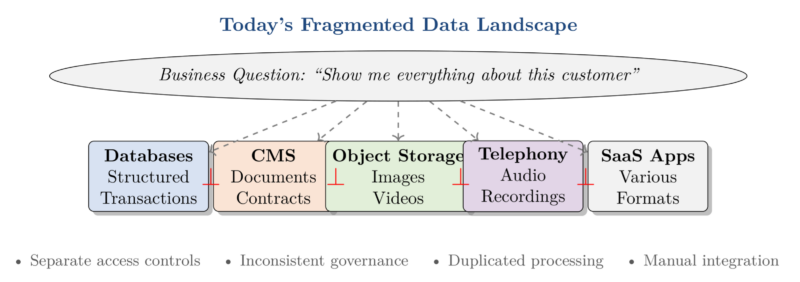
Consider how a typical enterprise handles its data today. Structured transactional data lives in databases and warehouses. Documents end up in content management systems. Images and videos sit in object storage or specialized media platforms. Audio recordings might be processed by separate transcription services and then forgotten in archive systems. Each of these silos has its own access patterns, its own governance model, and its own analytical capabilities – or lack thereof.
The result is what I’d call analytical poverty in the midst of data abundance. Organizations are sitting on enormous volumes of valuable information that they cannot effectively query, correlate, or learn from. A claims adjuster investigating insurance fraud might have access to the structured claim data, but extracting insights from supporting documents, photos of damage, and recorded customer calls requires manual review or coordination across multiple specialized tools.
Data Architecture Intensive
Learn how to design unified, future-ready data architectures that bring together operational, analytical, and AI data – December 1–2, 2026.

This fragmentation creates four specific problems that limit business value:
Data silos prevent unified analytics.
When information about the same business event lives in multiple systems with no common identifier or query layer, you cannot easily ask questions that span modalities. “Show me all interactions with this customer last month” becomes a research project rather than a query.
Duplicated processing wastes resources.
The same document might be processed multiple times by different systems for different purposes – once for storage, once for search, once for compliance, once for analytics. Each pass extracts a fraction of the available value.
Inconsistent governance creates risk.
When unstructured content is governed separately from structured data, organizations struggle to apply consistent policies around access, retention, and privacy. This is particularly problematic as regulatory requirements like GDPR and emerging AI regulations demand unified accountability.
Limited AI potential.
Modern AI applications, particularly those using retrieval-augmented generation, depend on access to all relevant organizational knowledge. When that knowledge is scattered across modality-specific systems, AI applications either operate with incomplete context or require expensive integration work for every use case.
What the Multimodal Lakehouse Changes
The multimodal lakehouse establishes a unified storage and processing layer where structured data, documents, images, audio, and video coexist as queryable assets. The key insight is that every data type, regardless of its original format, can be represented in ways that make it accessible through standard analytical interfaces.
This doesn’t mean storing everything as text or losing the richness of original formats. Instead, it means maintaining the original content while also extracting and storing structured representations – the entities mentioned in a document, the objects detected in an image, the sentiment expressed in an audio recording, the actions performed in a video.
These extracted representations live alongside structured business data in the same analytical layer. A SQL query can join customer transaction data with sentiment scores from their service calls and entities mentioned in their support emails. An AI application can retrieve relevant context from documents, images, and audio recordings through a single search interface.
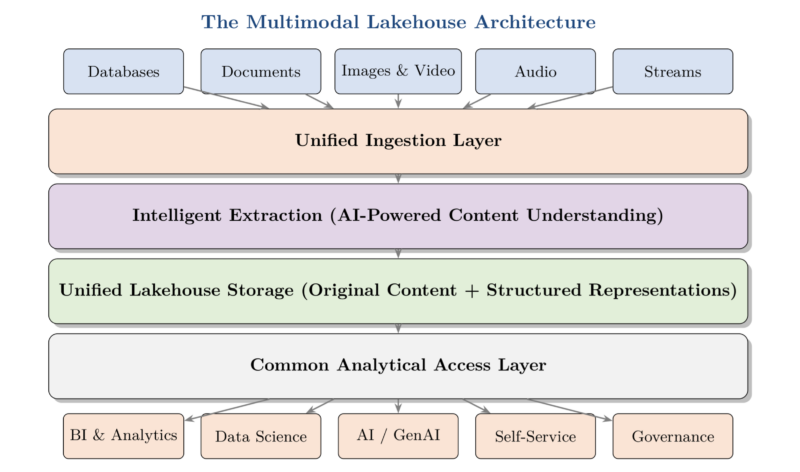
The architecture rests on three foundational capabilities:
Unified ingestion means all data types enter through the same governance and management layer, regardless of their original source or format. This eliminates the proliferation of specialized ingestion pipelines and ensures consistent handling.
Intelligent extraction uses modern AI services to derive structured information from unstructured content automatically. Documents become extractable text with identified entities. Images become descriptions with detected objects. Audio becomes transcripts with sentiment analysis. Video becomes scene descriptions with detected actions.
Common analytical access ensures that all extracted information, regardless of its source modality, can be queried through standard analytical interfaces. Business analysts can use familiar tools, data scientists can access information through their preferred platforms, and AI applications can retrieve context through unified search.
The Business Outcomes That Matter
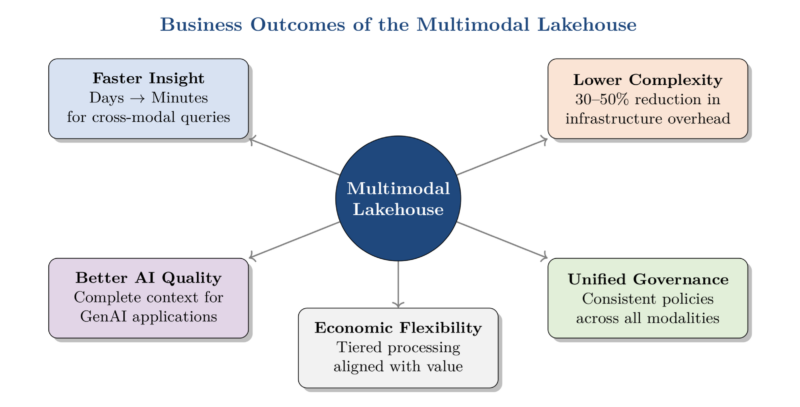
Organizations adopting multimodal lakehouse architectures report several concrete benefits that justify the investment.
Faster time to insight comes from eliminating the integration work previously required to combine information across modalities. Analysts who once needed days to gather data for a complex investigation can now answer the same questions in minutes through a single query interface.
Reduced operational overhead results from consolidating multiple specialized systems into a unified platform. Organizations report 30% to 50% reductions in data infrastructure complexity when migrating from siloed approaches to multimodal lakehouses.
Improved AI application quality is perhaps the most significant benefit in 2026. AI applications that previously hallucinated or provided incomplete answers because they could only access part of the relevant context now produce more accurate responses because they can draw on all organizational knowledge.
Stronger governance posture emerges naturally when all data flows through a unified layer. Compliance teams can apply consistent policies, audit trails span all modalities, and sensitive information detection can run uniformly across content types.
Better economic flexibility comes from separating storage from compute and from the ability to choose appropriate processing approaches for different content types. Not every document needs the same level of analysis, and the multimodal lakehouse enables tiered processing strategies that align cost with business value.
A Real-World Example
A mid-sized property and casualty insurer faced a familiar challenge. Their claims processing involved structured policy data in their core system, scanned claim forms in a content management system, photos of damage in object storage, and recorded customer calls in their telephony platform. Each system had its own access controls, its own analytics capabilities, and its own retention policies.
When the company wanted to build a fraud detection capability, they discovered they couldn’t easily correlate signals across these systems. Suspicious patterns visible only when combining customer call sentiment with document quality and photo authenticity remained invisible to their analysts.
After implementing a multimodal lakehouse architecture, the company unified all claim-related content under a single analytical layer. Documents, images, and audio recordings were processed through automated extraction services, with the resulting structured representations stored alongside the original content. Their fraud detection capability could now identify suspicious patterns across modalities, and their analysts could investigate complex claims without coordinating across multiple platforms.
The business impact extended beyond fraud detection. Customer service representatives gained instant access to all interaction history regardless of channel. Compliance teams could apply consistent retention policies across all claim-related content. Their AI-powered claims triage system, previously limited to structured data, could now factor in document complexity, photo evidence, and customer sentiment.
Strategic Considerations for Adoption
Moving toward a multimodal lakehouse architecture is more than a technology decision. It requires rethinking several aspects of the data strategy.
Governance must evolve from system-specific to content-aware. Traditional governance models built around specific systems don’t translate well to a unified architecture. Organizations need policies that follow content based on its characteristics, not its location.
Data engineering capabilities need to expand beyond ETL. While extraction and transformation remain important, modern data teams need familiarity with AI-powered content processing, vector databases, and semantic search.
Business stakeholders need to be educated about new possibilities. When analysts discover they can ask questions that previously required specialized teams, the demand for analytical capabilities expands rapidly. Organizations need to prepare for this shift in expectations.
Cost models require new approaches. The multimodal lakehouse can be significantly more cost-effective than maintaining multiple specialized systems, but only with thoughtful tiering strategies that align processing investment with content value.
Looking Ahead
The multimodal lakehouse isn’t a destination – it’s a foundation for the next generation of data-driven applications. As AI capabilities continue to advance, the ability to query and reason across all organizational data will become a baseline expectation rather than a competitive advantage.
Organizations that establish this foundation now position themselves to take advantage of capabilities that don’t yet exist. The specific AI tools and analytical techniques will continue to evolve, but the underlying architectural pattern – unified storage and processing of all content types – will remain valuable for years to come.
The question isn’t whether your organization will eventually need multimodal data capabilities. It’s whether you’ll build them through deliberate architectural choices or through the accumulation of point solutions that will eventually require painful consolidation. The organizations making intentional choices now are building the data foundations their AI strategies depend on.
Optimize Your Data Catalog
Learn how to successfully implement, govern, and drive the adoption of an enterprise data catalog.