
The DAMA Guide to the Data Management Body of Knowledge (DMBOK) serves as a testament to the ever-evolving nature of the data world. The second edition of the book, released by DAMA International in 2017, features updated contributions from more than 120 data professionals and highlights 11 core data management “knowledge areas.”
In 2025, DAMA International launched the DMBOK 3.0 project, a community-driven update to modernize the framework for AI governance, cloud-native environments, and contemporary data platforms. The update is scheduled for publication in 2027.
As a whole, the 600-page tome is considered the gold standard of reference guides for data professionals, whether they are just starting in the industry or have been practicing within it for decades. Knowledge workers, data governance leads, project managers, executives, technical staff, data analysts, data architects, and anyone else involved with data will find the DMBOK a valuable resource.
What Does the DMBOK Cover?
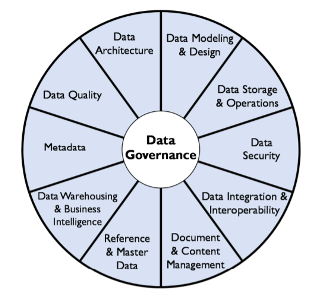
The DMBOK includes the latest processes, best practices, and principles within data management. It focuses on 11 main topics:
- Data Governance
- Data Architecture
- Data Modeling & Design
- Data Storage & Operations
- Data Security
- Data Integration & Interoperability
- Documents & Content
- Reference & Master Data
- Data Warehousing & Business Intelligence
- Metadata
- Data Quality
The most recent 2.0 edition of the DMBOK contains dedicated sections for data ethics, big data, data integration and interoperability, and data management maturity assessment. To illustrate how these different subjects are interconnected, DAMA International created the Data Management Framework, or DAMA Wheel. It includes the 11 knowledge areas and puts data governance at the center of the wheel, to highlight how it underpins every data management activity.
The Goals of the DMBOK
The DMBOK offers a variety of benefits to data professionals who use it.
- Learn about data governance best practices, roles and responsibilities, deliverables and metrics, and maturity models for data management.
- Standardize data management practices across the field.
- Create as a functional framework for the implementation of these practices in any business context.
- Establish a formal vocabulary for these concepts.
- Clarify the scope of what these practices can and cannot do.
- Get a vendor-neutral perspective of management practices and potential alternatives for specific situations.
Live Online Course: Data Management Fundamentals
Gain a comprehensive foundation in data management and prepare for CDMP certification.

How to Use DMBOK in Your Organization
A common misconception is that the DMBOK serves as an implementation map that guides a company step by step toward its data management goals. Instead, DMBOK provides a shared vocabulary and framework that describes what your ultimate data management destination should look like. It’s up to you to decide the best way to adapt DMBOK principles to reach your goals given your business’s unique characteristics.
The following use cases illustrate what DMBOK is, what it offers for AI management, and why you should apply the DMBOK framework to address common data governance challenges.
Building or Auditing a Data Governance Program
A primary benefit of the DMBOK framework for data governance is its ability to assign clear ownership, decision rights, and accountability. This ties governance directly to specific data architectures, data quality, metadata, security, and lifecycle management. It allows governance to scale smoothly across organizations without adding a significant amount of complexity to data management tasks.
DMBOK helps companies avoid data silos and fragmented environments by making data integration an integral part of their governance strategy.
- Interoperability standards become a priority
- Metadata and lineage controls enhance visibility across systems
- Governance goals are linked directly to measurable business outcomes
- Existing organizational practices are mapped against DMBOK roles, activities, and responsibilities
The DMBOK maturity model is used commonly by CDOs and data governance leads to give them a clear picture of the current state of their data governance practices, and what they will need in the future.
Establishing a Common Vocabulary Across Teams
Data management becomes much simpler when everyone in the organization speaks the same language. The meaning of terms such as “data owner,” “data steward,” “metadata,” and “master data” vary widely from company to company. DMBOK applies formal definitions for these and other terms to reduce misunderstandings within and between teams and departments. The framework’s common language applies to diverse roles, including those related to data stewardship, data quality, data architectures, metadata management, and security.
In particular, data programs at enterprises commonly involve teams from different business units that have developed their own terminology. DMBOK promotes coherent governance by ensuring that all operating groups in the organization share the same reference definitions. A shared vocabulary improves data quality by reducing the likelihood of missing or inconsistent data values, nonstandard naming conventions, inaccurate metadata, and ambiguous data ownership.
Preparing for CDMP Certification
DMBOK training serves as the foundation for DAMA’s Certified Data Management Professional (CDMP) credential, which is recognized as the premier certificate for data professionals. Passing the CDMP exam demonstrates proficiency in data governance as well as many other disciplines, including data quality, data architecture, metadata and reference data, data security, and data modeling and design.
The 11 DMBOK knowledge areas are the primary resource for professionals preparing for CDMP certification. They form the foundation of DATAVERSITY’s CDMP training programs that feature more than 40 separate courses for different specialization levels and in a variety of learning formats. These include:
- CDMP Certification and the DMBOK Learning Plan
- DMBOK and CDMP Preparation: Data Governance Specialist Learning Plan
- DMBOK and CDMP Preparation: Data Quality Specialist Learning Plan
- DMBOK and CDMP Preparation: Data Modeling Specialist Learning Plan
- DMBOK and CDMP Preparation: Metadata Management Specialist Learning Plan
- DMBOK and CDMP Preparation: Master and Reference Data Management Specialist Learning Plan
- CDMP Lunch and Learn Study Group with Mark Horseman
DATAVERSITY is one of the only DAMA-endorsed Registered Education Providers in North America, offering a range of flexible, self-paced learning options that feature live, online, and instructor-led courses. The close association makes DATAVERSITY’s CDMP preparation program the most effective and efficient option for data practitioners.
CDMP Prep Made Easy
Prep smarter with expert-led courses, DMBoK coverage, and practice tests built to help you pass the CDMP exam.
What’s Changing in DMBOK 3.0?
DMBOK 2.0 remains the active standard until the publication of DMBOK 3.0, which is scheduled for 2027. What DMBOK 3.0 will update focuses primarily on AI governance, cloud-native data environments, and contemporary data practices:
- AI governance and AI lifecycle oversight integrates AI management responsibility with existing data management best practices. This broadens the scope of DMBOK beyond technical matters to encompass how a company’s AI use impacts its organizational structure and decision-making processes. It also covers bias checks, AI quality tests, and the lineage of data models. The changes acknowledge that AI governance is a natural extension of data management practice rather than a separate discipline.
- Cloud-native data environments go beyond merely hosting apps in the cloud to include the development of apps on cloud platforms. DMBOK 3.0 establishes a management framework for cloud-native architectures, data mesh networks, and distributed data platforms. By contrast, DMBOK 2.0 is limited to guidelines for on-premises and cloud-hosted environments. The update will boost the resilience, scalability, and observability of cloud apps while facilitating continuous deployment with no fixed-infrastructure impediments.
- Contemporary data practices extend far beyond databases and report generation to encompass all business processes. DMBOK 2.0 predates the rise of data products, data contracts, and highly integrated data environments. Modern distributed data ecosystems contain AI models, cloud data platforms, unstructured data, and heightened compliance related to transparency and ethics that aren’t referenced in DMBOK 2.0.
Data management professionals are able to participate in DAMA’s DMBOK 3.0 update through the organization’s community engagement activities. Options include completing a benchmark survey, participating in focus groups, responding to calls for contributions, and offering insights using DAMA’s feedback portal. The most effective way to keep up with the evolution of DMBOK principles in version 3.0 is by signing up for DATAVERSITY’s CDMP and DMBOK training.
DMBOK and AI Governance: What Data Professionals Need to Know
Many of the most important concepts explained in DMBOK relate directly to AI governance. These include quality testing for the data that’s at the heart of AI models, establishing data lineage, and managing metadata are all aspects of responsible AI use. The most effective way for data professionals to meet AI governance demands is by extending their current compliance activities to include DMBOK’s standard data governance practices.
- Data Governance: Data systems are accessed by an array of autonomous and human-managed AI models, some working independently and some collectively. AI-ready data governance establishes controls for data prompts and data retrieval that are intended to prevent hallucinations and other non-compliant outputs. The 11 DMBOK knowledge areas establish the foundation for policies, roles, and accountability for all data assets used for AI training, model inputs, and decision outputs.
- Data Quality: AI models rely on high-quality training data to improve the accuracy of their predictions and the reliability of outcomes. Existing measures of data quality apply to AI models: accuracy, consistency, completeness, timeliness, and relevance. The data quality frameworks built into the DMBOK apply consistent operational controls to profiling, validation, cleansing, and monitoring of the data that powers AI models.
- Metadata Management: AI governance requires that models demonstrate how and when the data they rely on was collected, transformed, and validated. The DMBOK’s metadata principles support AI model provenance by helping to explain the context in which the data was collected and applied. Data lineage captures the details of transformations such as code changes, algorithm parameters, and validation procedures. This also improves the auditability of AI decision-making processes.
- Data Security: The proliferation of AI tools in the workplace creates unprecedented security challenges, starting with identification of all systems that have AI components. High-risk activities include access to and processing of private data, automated decision-making, and consent management, including the skyrocketing number of data subject requests. The data security knowledge areas built into DMBOK provide a framework for managing AI model access controls, encryption, and privacy compliance.
DMBOK 3.0 promises to facilitate the broadening of current governance controls to the collection and validation of the data that’s used to train and apply AI models. Data professionals should prepare now for the new AI governance data management knowledge area that will be included in the forthcoming DMBOK 3.0.
Want to become a data governance specialist?
Gain a solid foundation in data governance and train for certification.