According to a 2025 survey of the IBM Institute for Business Value (IBV), more than 25% of organizations estimate that poor data quality costs them five million dollars a year, while 7 report losses of more than 25 million dollars.
While this is not a new phenomenon, artificial intelligence (AI) has made data quality failures more visible. Traditional analytics tolerated partial or delayed data because humans could interpret and correct the output. AI systems (especially recommendation engines, credit agents, fraud analyzers, underwriters, claims engines, and clinical risk models) act closer to the point of decision to remove this filter. Today, agentic AI is deployed across multiple use cases and industries (see box), and these systems amplify the inherited data quality issues. Agents built on inconsistent, biased, and incomplete data multiply issues at scale.
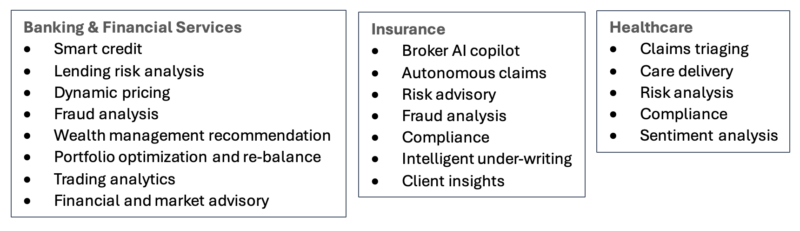
When AI is embedded into workflows, data quality is not just a technical concern, but a huge risk for operations, customer experience, and governance.
Where Data Quality Breaks in AI Workflows
In multi-agent workflows, AI agent handoff is both a critical requirement and the weakest link in maintaining data quality. Vital context is often lost at this point.
Take the workflow of retail banking across the areas of customer management, account opening, KYC/AML verification, fraud prevention and detection, underwriting, risk and compliance, collections, payments, and servicing. In customer management, the data that agents gather in customer targeting and behavior prediction forms the basis of customer information management. The right and single source of truth can provide a clean and secure data handoff for verification (KYC and AML), fraud prevention and underwriting in account opening; for compliance management and dispute management in risk and compliance; for collections and recovery management in defaults and receivables management. Similarly, an agent managing approvals needs data on supplier pricing updated in real time to commit orders at valid rates. And an agent handling patient scheduling must confidently pull data from a record that has been updated with the right handoff in real time to schedule appointments and provide the right patient information.
Want to become a data quality specialist?
Learn about the most essential aspects of data quality management and prepare to take the CDMP exam.

It is at these critical handoff points that data quality usually breaks, due to either incompleteness, inconsistency, or outdatedness. In AI-led automated workflows, the buffer of human oversight is removed – and poor data actually scales and accelerates error rates in downstream workflows in an uncontrolled manner.
Most enterprises do not have one data quality problem. They have hundreds of small quality failures occurring across workflow handoffs. It is therefore vital that data quality be embedded into the business flow and not checked only after data reaches a warehouse.
A Framework to Fix Data Quality Inside the Workflow
Fixing data quality inside an AI workflow is the way to go. Here are five practical guidelines to make this happen.
1. Start with the AI Decision, Not the Dataset
Knowing the decision that the AI system will impact and influence is a very good starting point. It could be loan approval, fraud alert, claim triaging, risk scoring, compliance exception, customer recommendation, or clinical prioritization. Zone in on the outcome and then define the critical data elements for the decision.
2. Build Data Contracts at Workflow Handoffs
Ensure that every source-to-system handoff has clear and non-negotiable expectations on the required fields, accepted formats, timelines, validation logic, consent and privacy tags, ownership, exception routing, etc.
3. Add Quality Checks Before AI Consumption
Before AI is deployed, ensure that checks are completed for accuracy, consistency, completeness, uniqueness, validity, timelines, representation (and bias), privacy classification, and consent. These are absolutely non-negotiable asks of data integrity.
4. Connect Lineage to Business Accountability
Lineage without ownership is but mere documentation. When workflow accountability is added to lineage, it becomes true governance. And lineage should show not only where data came from, but also who is accountable when it breaks.
5. Create Feedback Loops from AI Outcomes Back to Source Systems
AI recommendations will be overridden, flagged, and challenged. They could be false fraud positives, incorrect customer recommendations, underwriting exceptions, corrections in claims triage, disputes in risk scores, or escalations in compliance reviews. When this happens, such signals should be fed back into data quality rules.
The right metrics are important to ensure continuous improvement of data quality in AI workflows. The table below gives a simple guide to achieve this.
| Metric | Why It Matters |
| Critical data element completeness | Shows whether AI has enough reliable inputs |
| Data freshness | Prevents stale decisions in risk, fraud, and customer workflows |
| Duplicate record rate | Reduces identity, personalization, and compliance errors |
| Consent coverage | Ensures AI is using data within approved purposes |
| Lineage coverage | Improves auditability and root-cause analysis |
| Exception resolution time | Shows whether workflow defects are being fixed quickly |
| Model override rate | Indicates where data or model assumptions may be failing |
| Data quality incident recurrence | Shows whether fixes are systemic or temporary |
Why Dashboards Alone Do Not Fix AI Data Quality
No one argues about the fact that AI can auto-summarize datasets, generate dashboards, and build a variety of reports in seconds. This begs the question, is speeding all that matters in fixing data quality? Are these dashboards found on the right decision of infrastructure? Is there a record of what was needed and expected, and did the output match the expectation? Or was the proxy merely made faster?
And that is why dashboards alone cannot solve the issue of data quality. Many organizations create data quality dashboards but fail to change the workflow behavior that causes poor data. Remember, the AI output is only as good as the context it is provided with. Context is a huge component of data quality, and it comes in many forms: institutional knowledge, business logic, decision histories, etc. It goes beyond facts to what we do with them. The context layer is what will make data quality relevant to AI workflows and remove the limitations of after-the-fact dashboard monitoring. Defects can be detected before they enter downstream systems. Business teams will now know who owns the fix, and AI teams can now correct source data instead of compensating with model tuning. Most importantly, the right privacy and consent actions can be taken before they become issues.
The essential thing to remember is this: While data quality dashboards are useful, they cannot be controlled. True control lies in the ability of workflows to prevent, flag, route, and correct defects before they influence AI decisions. And for this to happen, the three layers of context, human judgement, and architecture must collaborate with the right intent and action.
Bad Data Quality Can Become a Major Data Privacy Risk
AI comes with its own data quality challenges. An AI agent depends heavily on the quality of data and the richness of the metadata it is provided, which it uses without any cross-checking that humans are prone to do. And when data is of poor quality, it creates a wide gap between what an AI agent thinks it knows and the actual truth.
At every stage of the AI journey, data quality and privacy are intricately connected. AI systems must unambiguously know which data is personal or sensitive, whether it is current and accurate, and if consent exists to use such personal data. More importantly, AI systems must be sure that data is being used for the right purpose, is meticulously anonymized, and that role-appropriate access has been given. Data must be governed by clear rules of lineage and retention, and great care must be taken to use synthetic, masked, and anonymized data in the right manner. And from a compliance perspective, one must be aware of laws such as the General Data Protection Regulation (GDPR), the California Consumer Privacy Act (CCPA), and Health Insurance Portability and Accountability Act (HIPAA), which provide individuals the right to access their personal data.
The approaches of privacy-by-design and quality-by-design should converge data in AI workflows. An AI workflow that uses inaccurate, stale, or overexposed customer data is both a quality failure and a trust failure.
It is vital to understand that AI-ready data is not created once but maintained continuously inside workflows. And data quality must be a living control layer. Because it will not be the number of models that determine AI maturity, but the ability to ensure that the data underpinning models are accurate, governed, explainable, and privacy-safe – and at the speed of the business.
Build your AI governance skills in 2026.
Explore training programs on AI governance, data governance, and compliance for data practitioners.