Data Governance Was Built to Answer a Different Question
Data governance has matured around a familiar set of objects and practices: glossaries, data dictionaries, catalogs, lineage, data domains, quality rules, policies, roles, responsibilities, and controls. These mechanisms have delivered real progress. They help organizations understand what data means, where it resides, where it came from, how it was transformed, who is responsible for it, and whether it meets defined quality thresholds.
Those are necessary questions. They are not, however, the questions that ultimately justify governance. Organizations do not govern data because they want more complete glossaries, richer catalogs, or more detailed lineage. They govern data because they must grant or deny, calculate or compensate, fund or refuse, authorize or suspend, declare or demonstrate. They must make decisions under conditions they can explain and defend.
This is where the gap appears. Traditional data governance approaches were designed primarily to document and manage data. They were not designed to reconstruct the complete chain linking a requirement to a critical business decision, then to the rules and data that support it, the controls that secure it, the evidence that proves it, and the actions required when expected conditions are no longer met.
The issue is therefore not a handful of missing features. It is a limitation of orientation, objects, and models.
The Missing Organizing Object: The Critical Business Decision
A data element can be perfectly documented without the organization being able to explain what it actually secures. A catalog may provide its definition, format, owner, source system, transformations, sensitivity, and quality rules. Yet it may still be impossible to answer several basic operational questions: Which critical decision depends on this data? Which requirement justifies its use? Which business rule mobilizes it? Which control verifies that it can be relied upon? What happens if it is inaccurate or late?
This limitation does not arise from poor catalog implementation. It follows from the catalog’s design. The catalog organizes knowledge about data. It can reference applications, processes, reports, and sometimes use cases, but it is rarely structured around the organization’s critical decision chains.
Critical decisions should therefore be treated as a governance reference framework in their own right. They are not workflow approvals, governance committee decisions, or abstract “decision rights.” They are the substantive business decisions through which the organization acts: approve a claim, determine eligibility, set a credit limit, release a payment, validate a regulatory filing, authorize access, or prioritize an intervention.
Once critical decisions are represented explicitly, other governance objects acquire a clearer purpose. Requirements frame decisions. Business rules operationalize them. Data supports them. Controls secure them. Evidence demonstrates them. Anomalies threaten them. Remediation restores the conditions under which they can be trusted.
Applied Data Governance Practitioner Certification
Validate your expertise and take your career to the next level.

Two Decision Chains Must Be Connected
A second distinction is essential: Business decisions are not data decisions.
A business decision concerns what the organization must do: grant, refuse, compensate, finance, authorize, declare, allocate, control, or prioritize. A data decision concerns the conditions under which data will be defined, produced, selected, shared, transformed, controlled, retained, corrected, or withdrawn from use.
Traditional governance often focuses on the second chain without explicitly linking it to the first. It assigns owners, defines standards, creates quality rules, and establishes controls, but it may not indicate which business decision these mechanisms are intended to secure. As a result, a quality failure may generate an alert without specifying whether processing should continue, whether a decision should be suspended, or whether previously made decisions should be reviewed.
The purpose of data governance is not to replace business decision-making. It is to establish the governed conditions under which business decisions can be made, explained, challenged, and demonstrated. This requires the two decision chains to be modeled separately and connected explicitly.
The Chain Traditional Models Cannot Reconstruct
Consider a regulatory or contractual requirement. Identifying it is not the same as operationalizing it. To become operational, the requirement must be linked to the critical decisions it frames, the business rules that implement it, the data required by those rules, the decisions that must be made about that data, the controls to be executed, the responsibilities involved, the evidence to be retained, and the deadlines to be met.
In most organizations, these elements already exist, but they are distributed across separate systems. The requirement is stored in a compliance repository. The business rules are embedded in an application or procedure. The data is described in a catalog. The quality rule is managed in a data quality tool. The control is registered on an internal control platform. The evidence sits in a document repository. The remediation action is tracked in a ticketing system.
The absolute absence of information is not the main problem. The problem is the absence of a coherent relational model that makes the chain navigable from end to end.
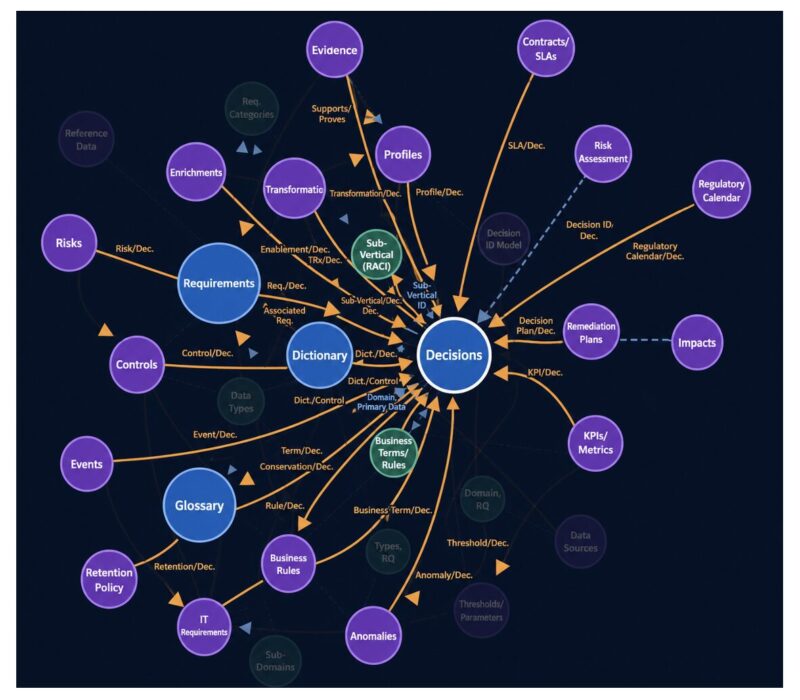
The density of these relationships matters. A requirement may govern several decisions. A decision may involve several rules and data elements. A control may reduce several risks. An anomaly may affect several decisions. A piece of evidence may substantiate several parts of the system. Adding a “requirement,” “decision,” or “evidence” field to a catalog does not transform the underlying orientation. The question is not how many additional metadata fields can be created, but where these objects sit in the model and how the organization can navigate among them.
Why Rules, Controls, and Evidence Lose Their Purpose
Organizations manage many categories of rules. Business rules specify eligibility conditions, thresholds, calculation methods, exceptions, priorities, and validation sequences. Data rules govern definition, format, quality, access, transformation, sharing, protection, and retention. Control rules determine frequency, population, alert thresholds, responsible parties, expected responses, and required evidence.
Each rule may be understandable within its own system. What is often missing is the architecture that explains how a requirement becomes a business rule, how that rule uses data, which data rules condition its use, and which controls verify the whole. An organization can therefore accumulate hundreds of rules without being able to demonstrate the rule system that secures a specific decision.
The same problem affects controls. A control should not be defined only by its title, owner, frequency, and result. It should be possible to determine what requirement justifies it, what rule it verifies, what data it uses, what decision it protects, what risk it reduces, what anomaly it can detect, what action it should trigger, and what evidence it produces.
Evidence also needs to become a first-class governance object. A policy proves that a rule was formalized; it does not prove that the rule was applied. A log proves that an operation occurred; it does not necessarily show which requirement or decision it concerned. An audit result proves that a check took place; it does not automatically demonstrate that all relevant decisions were covered. Evidence becomes meaningful only when it is linked to what it substantiates.
Anomalies Must Be Governed by Their Consequences
Data quality tools are good at detecting missing values, duplicates, inconsistencies, delays, breaks, and format errors. Yet an anomaly has no absolute severity. Its criticality depends on the decision it affects, the requirement that may no longer be met, the risk it increases, and the time available to correct it.
The same issue may be tolerable in exploratory analysis and unacceptable in a regulatory filing, a benefit calculation, or an individual eligibility decision. Governing an anomaly therefore requires more than recording an issue and assigning an owner. The organization must know whether the affected data should be withdrawn, whether processing should be suspended, whether an already completed decision should be reviewed, what compensating measures are required, who must arbitrate, and what proof of correction must be retained.
Remediation should similarly be evaluated by what it restores. Closing a ticket is not the same as restoring the conditions necessary for a trusted decision. A remediation action should reveal which decisions remain vulnerable until completion, what residual risk persists, which temporary controls are active, and what evidence will demonstrate that trust has been restored.
Time must also be part of the model. Requirements take effect, controls are due, data expires, anomalies require responses, evidence must be retained, and remediation commitments have deadlines. A governance system that represents expected operating conditions without representing events and deadlines describes governance but does not fully enable its management.
Why Governance Programs Disconnect from Their Stakeholders
The absence of this decision-centered chain helps explain three recurring disconnections that are too often attributed solely to sponsorship, culture, or change management.
Regulators and auditors do not stop at asking whether a glossary, policy, catalog, or lineage exists. They want to understand how a requirement was interpreted, which decisions it frames, which rules were applied, which data was used, which controls were performed, which deviations occurred, and what evidence supports the organization’s position. Extensive repositories may exist while the organization remains unable to reconstruct that chain quickly.
Senior executives manage decisions, risks, commitments, responsibilities, and results. Governance programs often report catalog completion rates, numbers of rules, percentages of assigned owners, or volumes of documented data. These indicators may help manage the program, but they do not show which critical decisions are better secured, which obligations can now be demonstrated, or which risks still require arbitration.
Business teams make decisions, execute operations, meet deadlines, and address deviations. When governance asks them to document data without showing which decisions that effort supports, the request appears administrative. The value becomes visible when a definition prevents divergent treatment, a quality rule avoids a calculation error, lineage explains a result, a control blocks obsolete data, or evidence protects the organization in a dispute.
These stakeholders do not reject governance because they fail to understand data. They often reject a representation of governance that does not reflect what they are responsible for deciding, controlling, or demonstrating.
From Data-Centered Governance to Decision-Oriented Governance
The necessary shift is not to abandon existing mechanisms. Glossaries, dictionaries, catalogs, lineage, quality rules, policies, and stewardship remain essential. The mistake is to treat them as the autonomous center of governance.
Decision-oriented governance places critical business decisions, requirements, business and control rules, and associated data at the center of a broader relational model. It distinguishes business decisions from data decisions and connects them. It treats controls, evidence, anomalies, remediation, and deadlines not as peripheral attachments but as integral governance objects.
This changes the governing question. Instead of asking only, “What data do we possess, what does it mean, and who is responsible for it?” the organization asks: “Which critical decisions must we secure? Which requirements govern them? Which rules and data allow us to make them? Which decisions must we make about that data? Which controls must we execute? Which evidence must we produce? What must happen when expected conditions are no longer met?”
This is not a functional extension to traditional data governance. It is a change in orientation. Data governance becomes capable not only of describing data assets, but of demonstrating what the organization can safely decide because those assets are governed.
Conclusion
Traditional approaches have significantly improved how organizations understand and manage data. Their limitations should not be confused with failure. They were built to answer descriptive and managerial questions about data, and they often answer those questions well.
They cannot, however, reasonably answer every operational question that arises when a requirement must be linked to a critical decision, that decision to rules and data, that data to controls, those controls to evidence, and deviations to remediation and deadlines. That limitation follows from their orientation and model, not merely from missing functionality.
Until governance represents the complete decision chain, organizations may continue to enrich their repositories without being able to demonstrate what those repositories actually secure. The next stage of data governance is therefore not simply more metadata. It is a model capable of connecting data knowledge to the decisions for which the organization is accountable.
Selected References
DAMA International, DAMA-DMBOK: Data Management Body of Knowledge, 2nd ed., Technics Publications, 2017.
EDM Council, Data Management Capability Assessment Model — DCAM, Version 3, EDM Council.
Khatri, V., and Brown, C. V., “Designing Data Governance,” Communications of the ACM, vol. 53, no. 1, Association for Computing Machinery — ACM, 2010, pp. 148–152.
ISACA, COBIT 2019 Framework: Governance and Management Objectives, ISACA, 2019.
Ngando Black, C., Connaissance des données — L’art d’opérationnaliser la gouvernance, Management & Data Science, 2025.
Data Governance Bootcamp
Learn strategies for planning, designing, and sustaining data governance programs – October 6, 13 & 20, 2026.