
Key Takeaways
- Engaging data stewards requires structured governance and empathy.
- Establishing metrics is essential for stewardship accountability and improvement.
- Strategic communication fosters successful change management.
The Importance of Data Governance and Stewardship
Data governance has become a strategic priority for many organizations to streamline operations and integrate data. According to DATAVERSITY’s recent Trends in Data Management Survey, nearly 75% of organizations have implemented data governance practices.
Following this trend, CPS Energy, a large municipally owned utility based in San Antonio, Texas, established a data governance program to support its enterprise resource planning (ERP) transformation. Their approach prioritized data stewardship – designating champions who would advocate for, communicate about, and collaborate on governance initiatives across the organization.
However, building a governance service became a significant challenge, as Marty Nash, business analyst at CPS Energy, explains. IT managed the data governance office (DGO) and business departments and paid salaries for the data stewards, leaving no direct way to financially incentivize them.
Finding alternate ways to engage data stewards became a must. At DATAVERSITY’s 2025 Data Governance & Information Quality (DGIQ) Conference, Nash joined Samantha Pixley, the managing principal at CPS Energy, and Sarah Neill, a program/system analyst and data steward, to discuss their journey in building and implementing a foundation for stewardship engagement.
Defining the Data Governance Structure
Before kicking off its data stewardship initiative in June 2024, CPS Energy’s leadership put together a data governance structure with stewardship engagement in mind. Nash said at DGIQ that CPS Energy started with this framework to get it going and “it is a work in progress.”
CPS Energy conceived of data governance in three levels with a data governance council (DGC), in charge of data governance policy and strategy. Each level had clear data governance roles and responsibilities. See the diagram below.
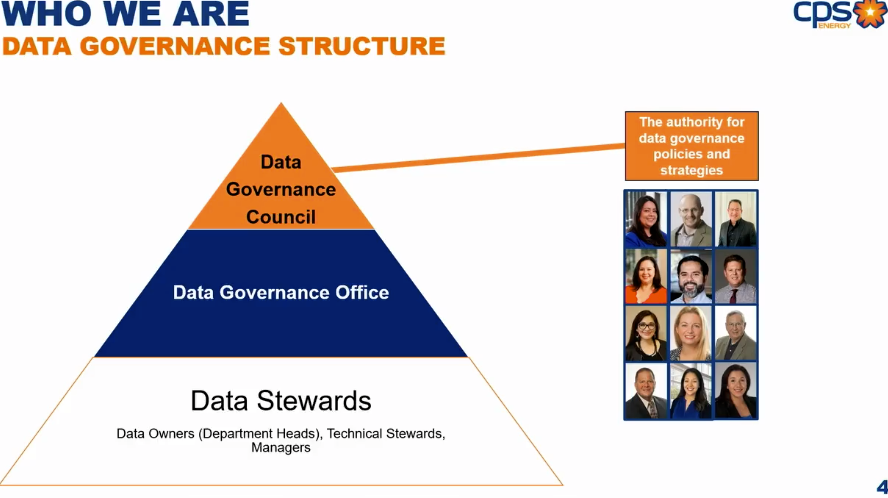
The DGC consisted of 12 different leaders across the organization that create and authorize data governance policies and strategies. It guided the DGO in its activities to lead governance, including stewardship engagement.
The DGO “buys into the stewards and gets them to produce,” said Nash. These stewards consisted of managers, technical stewards, and data owners. The data owners were department heads who already manage records within the organization. The DGO trained these people to identify potential data stewards that would best handle the stewardship tasks delegated to them.
Live Online Course: Data Governance Sprint
Learn techniques to launch or reinvigorate a data governance program.

Steering Data Stewardship Engagement with Metrics
With so many demands on their time and limited resources, data stewards needed to know what the DGO expected. Additionally, the DGO needed to update the DGC in its stewardship engagement, meeting governance policies and strategies.
So, the DGC established metrics to meet these requirements, including:
- The number of data stewards established: CPS Energy used this metric to ensure coverage of all its business units. This value identified any gaps “driving the DGO to get more engagement there,” said Nash.
- Attendance at meetings and trainings: Nash explained that the company prioritized monthly trainings needed to accomplish stewardship tasks. So, the DGO tracked stewardship attendance and used this data to circle back to any stewards who missed multiple meetings in a row and re-engage them.
- Feedback and survey loop: At the end of every meeting, the DGO collected feedback to gauge the level of excitement and engagement from the stewards. Ratings on the comfort level, support level, areas of improvement, and areas needed for specific help informed the DGO on how to provide the best services for the stewards.
- Data catalog and quality metrics: These values expressed the progress toward building out the data catalog. Nash says that it took a bit of time because the stewardship team was small.
- Working group updates: CPS Energy had a working group for every major initiative. This group steered activities to align with roadmap objectives and provided updates.
Each month, the DGO collected and presented these values to the DGC. Additionally, as Nash mentioned, these metrics “provide the opportunity for the DGC to give governance direction and feedback.”
Availability and Empathy for Data Stewards
Steering data stewardship through metrics alone is not a straightforward process. Stewards have primary responsibilities to their departments and frequently express the common struggle, “I don’t have time,” said Nash:
“To handle this challenge, you have to be empathetic and realize that sometimes governance initiatives and demands aren’t going to match the department’s needs.”
He and his other four DGO teammates took extra care to be accessible and helpful.
Providing a SharePoint portal with training materials, templates, and documentation – and regularly maintaining it – proved invaluable, said Neill:
“It’s a one-stop shop for us data stewards. It might be a week or maybe a month and a half before I get to a data governance assignment. This is a great place for me to follow up on a training assignment from two months ago, but I couldn’t get to it because my real job took over. This portal makes all the meetings and trainings available, so I can come back to it when I have time.”
Additionally, the DGO maintained a shared inbox that stewards could email to and receive “immediate feedback, within reason,” said Nash. When stewards didn’t have time for governance tasks, the DGO team could step in and ask how they could help lighten the load.
The DGO added a personal touch through office hours that occurred consistently on Thursdays and Fridays. Nash explained that sometimes it was busier than others. Sometimes, “data stewards stay there the whole time and don’t talk anything about data stewardship. They just tell us what they’re doing this weekend.” This timeslot still played an important role in networking and providing face-to-face availability for questions.
Managing Change with Communication
The DGO’s success with availability and empathy came directly from effectively managing rapid changes through strategic communications. It celebrated stewardship successes and clearly set limits with leadership. For example, the DGC agreed to keep data stewardship work to approximately 10% of weekly tasks while advancing rapidly to goals.
Pixley stressed the urgency driving their approach: “We’re on the clock. We have to stand up the program by autumn of 2025.” To meet the ERP transformation deadline, the DGO needed everyone aligned without overwhelming them with excessive communications.
Their streamlined approach included:
- Limiting email blasts to prevent information overload
- Building community through focused interactions
- Moving everyone forward together at the same pace
Neill highlighted the impact of this approach:
“The change management program at your enterprise is awesome. Again, we have all these other things to do. So, having a change management strategy to deliver these messages to leadership and to the data stewards has really helped stewardship engagement.”
Efficient communications kept the work consistent – only requiring stewards to dedicate two full working days over a two-week period and built off existing momentum. For example, the DGO hosted a kick-off party, distributing swag like coffee mugs, while training stewards on elevator pitches to champion data governance in their teams. These targeted communication efforts kept stewards consistently engaged and enthusiastic about the program.
Ready for the Next Objective
Stewardship engagement formed the backbone of CPS Energy’s governance program and proved highly valuable. Of the company’s 97 data stewards, 84% attended all training following stewardship implementation.
The company had 1,700 business glossaries, “including the data created in their department and reports,” said Pixley. As the company’s ERP program got started, it came to the data governance office for its documentation of the reports. So, the ERP program received what they needed.
These excellent numbers came about from building a solid foundation for data stewardship engagement. The work included defining a data governance structure, steering engagement with metrics, and guiding communications with the help of change management. Pixley added:
“I think our biggest success, from data stewardship engagement, was introducing the idea of data governance at our company. We see everyone is ready to participate and learn more about it. We know what data we have, and we can develop a policy with which people are ready to comply.”
CPS Energy had data stewards expressing excitement about data governance. This enthusiasm would help the company meet its next objective – data quality training – with ease.
Learn Together, Lead Together
Five days. 96 sessions. Dozens of actionable takeaways. Learn from industry experts and connect with data professionals at our DGIQ + EDW conference this May.
Save 15% on registration with code DATAEDU.