Key Takeaways
- The value of a data strategy lies in the conversations that create it. These conversations shift the focus from what to do to include why and how data supports organizational objectives.
- AI accelerates governance administration by automating tagging, lineage mapping, and compliance. This frees teams to focus on strategic planning and implementation.
- Effective data strategies come with regular practice. Teams cycle through each strategy by prioritizing and alleviating a constraint and repeating the process. That way, organizations build their competitive advantages incrementally and proactively manage risks.
A Different Approach to Data Strategy
Most organizations have a data strategy problem – but not the one they think. While DATAVERSITY research finds that 60% of organizations have documented data strategies, 80% of their data remains redundant, obsolete, or trivial.
The disconnect is that companies treat data strategy as a final deliverable – a document to complete and shelve. Peter Aiken, professor of information systems at VCU and founder of Anything Awesome, observes that organizations spend “too much time writing the perfect plans at the expense of becoming actually proficient.”
Aiken proposes a different approach. Data strategy specifies how data assets support organizational strategy. It serves as the alignment mechanism that helps teams agree on why data matters and how to act on it. The real value lies not in the strategy document itself but in the iterative activities that create and evolve data capabilities.
In his recent Data-Ed Online webinar, Aiken demonstrated how iteration, data governance, and AI augmentation provide proven practices that accelerate data strategy implementation.
The Cyclical Approach
Data strategy is a pattern in a stream of decisions that requires practice and cyclical improvement. Organizations improve their data and how people use it through iterations.
Aiken gave the example of Rolls-Royce. Its old business model involved selling large jet engines as a vendor. But they wanted to be a service company to airlines, providing hours of powered thrust. Rolls-Royce adjusted its data strategy by demonstrating time savings in changing engines at NASCAR races. Then they could take that information to the airlines, showing them how they can reduce engine downtime.
Aiken recommended using a constraint paradigm, introduced by Eliyahu Goldratt, as shown in the diagram below, to get the most from a cyclical strategic approach.
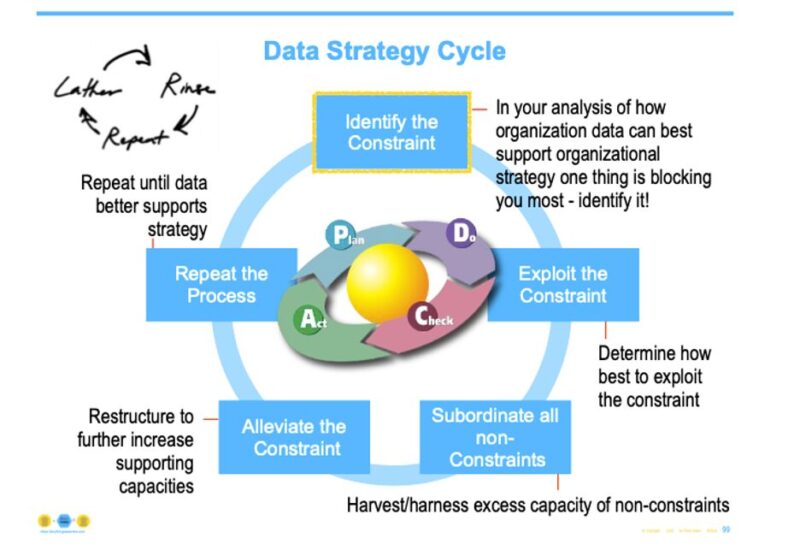
Image courtesy Peter Aiken
Aiken suggested taking the following steps to apply the theory of constraints:
- Identify the constraint: Pick one issue, such as a lack of time.
- Exploit: Decide how to ease this pain for everyone, gaining their support.
- Subordinate all non-constraints: Leverage resources, such as employees that use and maintain the data.
- Alleviate the constraint: Remove unused or stale data.
- Repeat: Repeat this cycle until data better supports the strategy.
After many cycles, organizations can gain a competitive advantage, adapting to market conditions, in small steps. Aiken noted that successful iterations also depend on guidance, based on the “effort, feedback, and what data assets need more support.” So, organizations must leverage the people who work closest to the data.
Where Data Governance Fits
The people closest to the data – data governance professionals – are essential resources. They know how to better organize the data and where to remove data rot.
These professionals are uniquely qualified to uncover valuable data. “Data governance manages data decisions with guidance,” Aiken explained.
A successful data governance program, spearheaded by a lead, improves data capacities and mitigates data challenges involving people and processes. It directs why and how to achieve the data strategy. Data stewards enact the strategy while effectively doing this with scarce resources.
Aiken suggested communicating these pieces as elevator pitches that resonate with the listener. For example, a techie sees the value of cleaning the data. But executives and managers would be more receptive to a goal of decreasing the number of undeliverable targeted marketing ads.
He emphasized that data governance is a DATA program, as shown in this visualization:
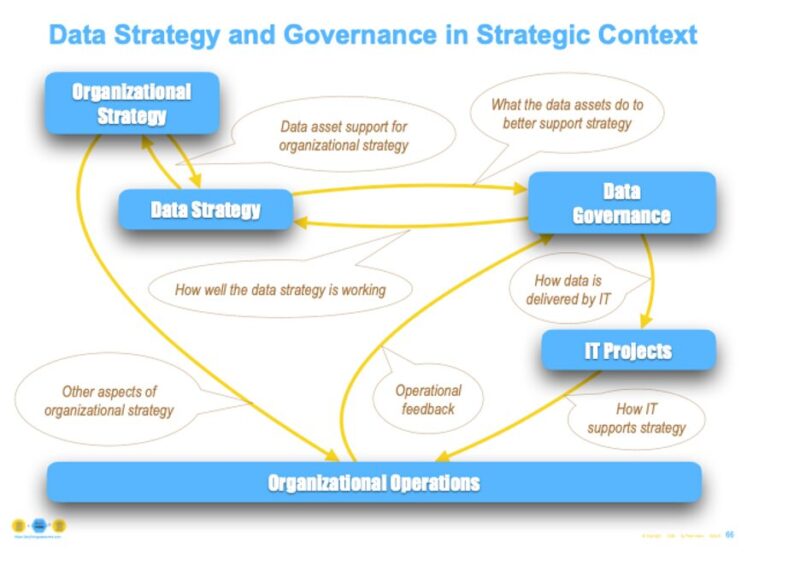
Image courtesy Peter Aiken
The data strategy determines the amount and type of data governance effort, feedback and what data assets need more support. This alignment between the data strategy and data governance improves people’s support and the way they use data to advance organizational goals.
Overcoming Implementation Barriers
While this alignment sounds straightforward, most organizations face significant roadblocks in practice. Aiken pointed to a critical mistake: “Oftentimes, people make the organizational data strategy subordinate to IT project priorities.” This approach misses the bigger business operational picture and undermines strategic intent by ignoring people and processes.
So, companies attempt to implement data governance initiatives but find themselves challenged by a lack of data-centric thinking and resistance to cultural change. Some organizations find their governance teams lack the capacity and skills to execute strategic cycles effectively.
Successful implementation requires five aligned elements: vision, skills, incentive, resources, and an action plan. Missing any one of these elements creates barriers: confusion without vision, anxiety without skills, resistance without incentives, frustration without resources, or false starts without a clear plan.
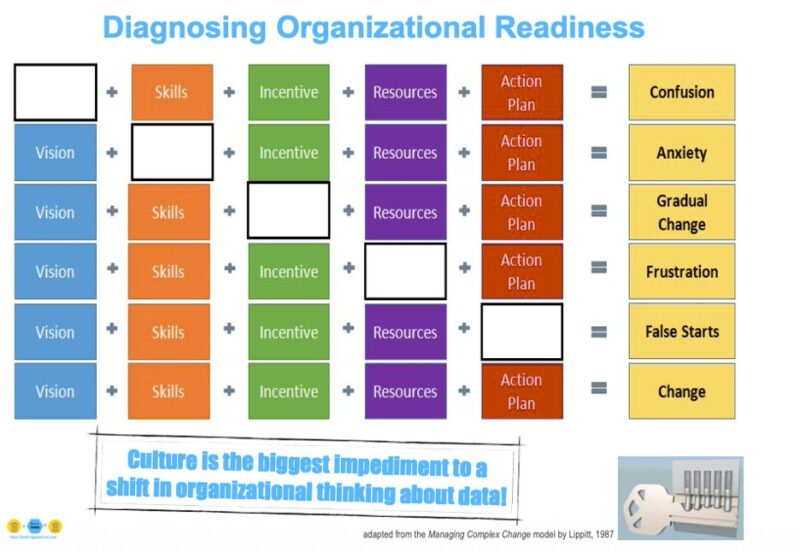
Image courtesy Peter Aiken
This is where AI becomes transformative – not as another technology purchase, but as a capacity multiplier. Aiken suggested “using AI to extend your specific knowledge worker capabilities.” By automating governance’s administrative burden, AI frees teams to focus on the strategic work that drives organizational value.
Removing Organizational Friction with AI
Generative AI does more than automate – it augments human expertise. The models role play, generate responses dynamically, and summarize complex topics in understandable ways.
Combine these proficiencies, and AI enhances strategic iteration and governance. Aiken noted that AI:
- Proactively labels and maps sensitive data and business terms: Instead of manually managing this information in a spreadsheet, AI smartly discovers and compiles all this information. This process reduces the time to insight.
- Conducts periodic audits andcontinuously monitors: AI and machine learning (ML) flag discrepancies for people to check. That way, organizations can discover breaches and mitigate risks before any damage is done.
- Facilitates data accessibility: AI chatbot answers allow anyone, with zero coding or SQL experience, to search and extract data. Consequently, data is available to less technically adept businesspeople.
According to Aiken, these AI capabilities strengthen the data governance efforts. Consequently, AI augments efforts to provide needs such as:
- Clear roles andresponsibilities: AI auto-suggests stewards, checks usage and access, and maps policy. Aiken added that when properly prompted for a CRUD matrix, AI gets 85% right.
- Robust data quality management: AI proactively finds problems and cleans the data. It automatically scales, learns, and updates the data quality rules, adapting to data as it changes.
- Strong data security and privacy controls: Aiken noted that AI acts as a force multiplier. In real time, it finds sensitive data, enforces access rules, ensures compliance, and protects data in transit or in use.
- Effective data stewardship: With AI, stewards become 10 times more productive, gaining time on the strategic, high-value tasks. AI’s smart tagging, continuous monitoring, self-healing data, and dynamic documentation reduce the complexity and amount of work data stewards face.
- Continuous improvement and adaptability: As organizations face uncertain market conditions with dynamic data, they need to adapt quickly. By engaging in real-time data discovery, proactively responding to governance rules, and fixing data on the fly, AI increases efficiencies in continuously supporting and improving data strategies.
As companies leverage AI to make data governance activities more efficient, they become more competitive and increase their governance capacities. In turn, these results provide more resources to alleviate the constraints and advance the strategy proactively.
From Theory to Practice
Aiken emphasized that the processes of data strategy creation and evolution extend business agile capabilities. These practices uncover and measure why and how the organizational data strategy supports business goals. Alignment across the organization builds support for the data strategy and improves how workers and managers use that data.
Data governance guides decisions about resources that support the strategy and provides feedback about how well it meets organizational needs. Through this work, data governance professionals identify the constraints and prioritize one to address, iteratively.
Data strategy is a learning process where organizations cycle through improvements. AI extends capabilities to evolve strategies and implement governance services more efficiently.
Aiken recommended starting with data strategy cycles focused on constraint identification and alleviation. While addressing each constraint, organizations should ask:
- How well can we improve our process?
- What business area should we tackle next?
- How do we balance delivering business value while developing data competency?
The key is consistent cycling through constraints, using AI to extend knowledge worker capabilities. Through this practice, organizations build competitive advantages incrementally and manage risks proactively, transforming data strategy from a static plan into strategic action.
Data Strategy Bootcamp
Gain the knowledge and frameworks to design and implement a data strategy that works.