The rush to deploy large language models (LLMs) and generative AI agents has brought the enterprise to a critical crossroads. Chief data officers (CDOs) are no longer valued merely for the volume or cleanliness of the data they govern; they are now the architects of the cognitive context fueling corporate intelligence.
However, as organizations attempt to scale autonomous AI workloads from novel pilots to production-grade systems, they are hitting a systemic wall: the inherent liability of model hallucinations and data vulnerabilities.
The industry standard for mitigating these risks has largely relied on in-context learning (ICL) – feeding sample datasets directly into an LLM’s prompt window to guide its logic. But as sophisticated data leaders are discovering, relying on raw models to interpret complex enterprise environments is a high-risk gamble. To build resilient, secure, and commercially viable AI ecosystems, organizations should consider adopting a governance-by-design approach. For many enterprises, this includes implementing a shared context capability, such as a metadata management platform or centralized metadata hub, to provide consistent business, technical, and operational context across data and AI initiatives.
Data Governance Intensive
Learn advanced strategies for building, sustaining, and scaling successful data governance programs.

The Semantic Trap: Where Raw Data Fails the Model
The fundamental flaw in modern enterprise AI deployment is the massive semantic gap between physical database structures and human intent. Enterprise data environments are historically built for system performance, not natural language processing.
Consider a typical data pipeline scenario: an administrative column tracking compliance documentation might be labeled under a highly condensed abbreviation like TaxImpsName. While a human data steward understands this represents an “Imposition Name,” an LLM is left to guess. More deceptively, a critical concept like “Taxpayer” might be masked entirely behind a generic system identifier like Company Code in legacy environments.
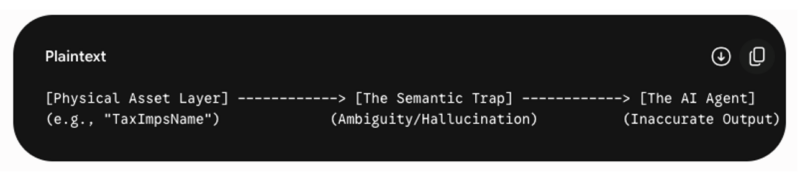
Expecting an LLM to autonomously cross-reference these fragmented relationships accurately is statistically unsustainable. If the model infers correctly, it is an educated guess; if it fails, it introduces catastrophic data poisoning or hallucinated logic into corporate decision-making.
Furthermore, stuffing these definitions into an LLM’s prompt window manually strains context limits, inflates token costs, and leaves the system vulnerable to data poisoning attacks. The alternative is clear: Organizations must separate the context layer from the data processing layer to run lean, agile, and secure AI operations.
The Active Context Blueprint
To bridge this semantic gap, data leaders need a structured abstraction layer that acts as the authoritative “brain” for enterprise AI agents. This is achieved by anchoring the AI architecture to a unified metadata hub structured around three vital intelligence pillars: business, technical, and operational metadata.
At the center of an AI-ready enterprise is a context engine that continuously connects business, technical, and operational metadata, transforming data assets into actionable organizational knowledge. Leading organizations are increasingly leveraging metadata not just to describe data, but to drive automated actions and business outcomes. Here are a few examples to that effect:
- When a dataset contains customer information and personally identifiable information (PII), metadata-driven policies can automatically enforce encryption, masking, or anonymization requirements in accordance with enterprise privacy standards.
- A customer interacts with an AI agent and makes a request such as, “Generate a report of all transactions for a specific entity within a particular geographic jurisdiction,” the agent can leverage a trusted context layer to understand the business meaning behind the request. By accessing certified metadata, including semantic definitions, lineage, business relationships, and ontology-based mappings, the agent can identify how the jurisdiction relates to other enterprise data assets and determine the most relevant information to retrieve. This contextual understanding enables the agent to deliver more accurate, personalized, and business-relevant insights while proactively surfacing related information that may help users make more informed decisions.
An effective context layer serves as a trusted bridge between enterprise data and AI applications. It enables AI assistants, agents, and analytics platforms to understand business meaning behind technical terminology, ensuring that outputs are not only accurate but aligned with organizational context and intent.
For business leaders, the value extends far beyond traditional data management. A unified context layer improves data discoverability, strengthens governance through stewardship, and reduces the operational complexity of managing information across fragmented environments. It also creates opportunities to personalize user experiences, automate governance processes, and unlock new sources of business value by embedding trusted context into customer-facing products and services.
When business, technical, and operational metadata are managed as interconnected dimensions of context, AI systems can deliver insights that are both technically accurate and business-relevant. The result is greater trust in AI-driven decisions, improved operational efficiency, and a scalable foundation for enterprise-wide AI adoption. Moreover, this architecture can transform data governance from a passive framework into an actionable driving force.
Operating Model to Support an Enterprise Context Strategy
Establishing clear accountability for business definitions, policies, semantic models, governance standards, privacy requirements, and security controls is essential to ensuring that AI systems operate on trusted, consistent, and approved knowledge. Without defined ownership, organizations risk scaling conflicting interpretations, inconsistent business rules, and unreliable AI outcomes. Successful organizations often adopt domain-driven ownership models, where business leaders and data stewards are accountable for business definitions, policies, and data quality, while governance councils provide enterprise-wide alignment, oversight, and conflict resolution.
A context layer, delivered through a data catalog or metadata management platform, should be treated as a strategic organizational capability rather than a one-time technology implementation. Like any critical enterprise asset, it requires ongoing investment, stewardship, and continuous improvement. Successful programs bring together business domain experts, data stewards, engineers, governance teams, and AI practitioners to collaboratively manage and evolve enterprise knowledge so that it can be effectively leveraged across analytics, automation, and AI initiatives.
The transition to AI also requires a cultural shift in how organizations think about data. Rather than managing technical assets in isolation, organizations must embed business knowledge and context directly into their data ecosystem. This demands modern stewardship practices, workflow-driven automation, and strong executive sponsorship to ensure context remains accurate, relevant, and trusted at scale. Organizations that treat context as a strategic asset will be better positioned to deliver trustworthy AI, accelerate decision-making, strengthen compliance, and unlock greater value from their data investments.
Successful organizations scale stewardship by automating routine governance activities while preserving human accountability for business decisions. Examples include:
- Metadata enrichment and certification: Newly onboarded data assets are automatically enriched with business context, classifications, lineage, and recommended descriptions. Designated stewards are then notified to review, validate, and certify the information before broader consumption.
- Business glossary governance: Changes to authoritative sources automatically trigger updates to business definitions, semantic models, and glossary terms. Proposed changes are routed through approval workflows to ensure consistency and governance compliance before publication.
- Risk and compliance monitoring: Data assets are continuously evaluated against governance policies, privacy requirements, and classification standards. Risk scores are automatically updated and surfaced through dashboards, enabling proactive oversight by governance and security teams.
- Data quality and policy enforcement: Data quality issues, access violations, and policy exceptions automatically generate alerts, remediation tasks, and escalation workflows. Service-level objectives help ensure critical issues are addressed in a timely manner and accountability is maintained.
By combining automation with stewardship and governance oversight, organizations can scale trusted context across thousands of data assets without creating administrative bottlenecks. This allows leaders to focus their efforts on strategic decision-making while ensuring enterprise knowledge remains accurate, governed, and AI-ready.
Executive Impact: Governance as a Growth Center
For chief data officers, the value of a context-driven enterprise extends beyond improving AI accuracy. When context is managed as a strategic asset, governance evolves from a compliance function into a business enabler.
- Reduce AI and regulatory risk by ensuring AI systems operate on trusted business definitions, governed data assets, and approved policies, improving consistency and supporting responsible AI initiatives.
- Accelerate decision-making by making enterprise knowledge easier to discover, understand, and trust, reducing the time employees and AI systems spend searching for and validating information.
- Scale personalized experiences by enabling AI systems to tailor interactions using business context, user roles, permissions, and domain-specific knowledge.
- Improve operational resilience by embedding governance controls directly into workflows, allowing organizations to detect risks, enforce policies, and respond to issues proactively rather than reactively.
- Unlock new sources of business value by combining operational telemetry, customer interactions, and business context to identify adoption patterns, optimization opportunities, and emerging revenue streams.
Ultimately, organizations that operationalize context as a governed enterprise capability will be better positioned to scale AI responsibly, improve productivity, strengthen compliance, and generate measurable business outcomes.
Conclusion
The primary bottleneck to enterprise AI scaling is no longer the raw intelligence of the large language model; it is the structural context of the data it consumes.
By implementing an architecture focused on a centralized metadata hub, modern enterprises can build data ecosystems that are fundamentally governed, inherently secure, and contextually aware. For organizations looking to lead the next wave of digital transformation, an active context engine is the definitive foundation for secure, reliable, and commercially impactful AI innovation.
Want to become a metadata management specialist?
Gain a solid foundation in metadata management and train for certification.