It seems like everybody’s talking about governance these days. Data governance, the principles that are addressed in the DAMA DMBOK, and the writings of Robert Seiner. BI governance, including many of the issues covered in my book Growing Business Intelligence. And now AI governance, an emerging topic of increasing concern to data and BI professionals. What do they do? How are they similar? How are they different? And how do we actually implement them?
In the first article in this series, I explained how governance processes of any kind are fundamentally the same as asset management. I then described how asset management, and specifically the management of data and information assets, is supposed to work.
In the second article in this series, I explained the fundamental principles of data governance, which is to say, data asset management.
In this article, I’m going to address some fundamentals of information governance, defined as information asset management.
Data Governance Intensive
Learn advanced strategies for building, sustaining, and scaling successful data governance programs.

Some of you may remember an essay I wrote some time ago called “How to Be a Data Shaman.” This essay became a chapter in my book Data Model Storytelling.
In this essay, I likened the role of the shaman in Native American tribes to Information and knowledge management activities in modern organizations. The shaman:
- Documents the history of what has been done in the past and helps the tribe understand how they got to where they are now
- Preserves a culture that unifies and sustains the tribe
- Teaches life lessons, such as the importance of honor and truthfulness
- Suggests strategies (through storytelling and prophecy) to help the tribe solve problems or accomplish a goal
- Explains the connections between the tribe and the world around them (i.e., the systems view)
- Helps provide stability, unity, and cohesion in times of crisis (such as the forced relocation of the tribe)
- Articulates a clear and compelling vision for the future of the tribe
The job of the shaman, essentially, is to understand and articulate the lessons of the past in ways that can be applied to the solution of current problems, and which suggest the best possible approaches to future problems and needs.
The information management responsibilities of the shaman manifest themselves in several different ways. Shamans are:
- Communicators: Providing help and advice to members of the tribe
- Educators: Passing along the tribal knowledge, experience, and expertise
- Healers: Helping to treat sickness and disease and addressing problems within the tribe
- Prophets: Helping the tribe anticipate and prepare for future challenges and opportunities
This suggests that information management is a multifaceted discipline that requires several different sets of skills to be effective. Information managers must be good communicators and storytellers, psychologists, educators, historians, teachers, strategists, and visionaries. They must be able to assess a given situation, determine the need, and apply their skills as required to meet that need.
So, how should information management be done inside of modern organizations? One approach that I advocate is called human-centered design (HCD). [1] In human-centered design, teams are assembled from specialists in a number of different disciplines to address a particular problem or need. An HCD team has not only designers and engineers; it also has, say, a psychologist, an anthropologist, a business analyst, a graphic designer, and a journalist – or some combination of interdisciplinary specialists selected to apply their expertise to the specific need at hand.
The team then conducts interviews of the people most directly impacted by the problem (not their managers or supervisors!). The team tries to immerse itself in the affected community, so as to understand the problem to the greatest extent possible. Empathy is considered one of the key mindsets of HCD.
The next step is brainstorming (or ideation), where the team meets to discuss possible solution approaches. The team tries to come up with as many ideas as possible, and then “bundle” groups of ideas into possible solution approaches.
An initial approach is agreed upon, and the goal becomes to quickly create a prototype solution to test whether the approach is viable. The team adopts a build-first mindset, seeking to implement the solution as quickly and cheaply as possible. If the prototype appears viable, the team iteratively refines the prototype (based on user feedback) into a production-grade implementation; otherwise, the solution is abandoned, the necessary lessons are discussed and learned, and another solution is chosen for prototyping.
Notice the various forms of information management that come into play in the HCD approach: First, the tapping of the wisdom and expertise of specialists from a wide variety of different fields. Second, empathetic immersion of the team into the community experiencing the problem. Third, the interviews with the affected community to help define the nature and scope of the problem. Fourth, the brainstorming sessions to identify possible solution approaches to the problem. Fifth, the iterative prototyping of the solution, based on feedback from the affected users. HCD is information management applied to organizational problems and business user needs.
Thomas Davenport, in his landmark book Information Ecology [2], quotes economist Garrett Hardin’s maxim that if you want to manage an ecosystem, “you can never do just one thing.” [3] In order to manage information effectively, Davenport asserts that organizations need to do the following things:
- Look at their organization holistically; that is, not merely from a business or a technology standpoint but from the point of view of all of its stakeholders – its customers, dealers, suppliers, regulators, and the communities in which it operates. What information does each of these stakeholder groups require in order to maintain an effective and productive relationship with the company? As I said in my book Building the Agile Database, if we don’t help our stakeholders succeed, they will help us fail.
- Integrate and manage diverse types of information, not just structured data in databases, but also document and text data, audio and video data, streaming data from intelligent devices, and so on. The new generation of AI tools can help companies make sense of non-structured and non-relational data and integrate this data into their decision-making processes.
- Recognize and respond to evolutionary change. Companies need to understand that information needs are continually changing; therefore, their information environment will need to evolve continually over time. Tom Davenport uses the example of the Northwest timber company whose information management environment was thrown into turmoil when the U.S. government declared the spotted owl to be an endangered species. If the company didn’t know where the owls lived in the forests, it couldn’t cut timber!
- Emphasize observation and description. Too many companies focus their information management efforts on modeling and predicting the future. Davenport asserts that a more effective approach is to develop maps of current information (such as information about current competitors, current user needs, or current market opportunities), rather than trying to anticipate the future business landscape.
- Focus on people and information behavior. Companies need to understand the political, social, and behavioral aspects of information management, and put policies in place that reward information sharing and use, and discourage information hoarding and decision-making that is not fact-based.
Davenport goes on to describe a three-part model for what he calls an Information Ecology: the Information Environment in which information is created and shared, the Organizational Environment that provides the business and technology context supporting the Information Environment, and the External Environment of customers, competitors, markets, regulators, and communities that constrain a company’s organizational efforts.
You’ll remember the Knowledge Management Pyramid concept I introduced in the previous article:
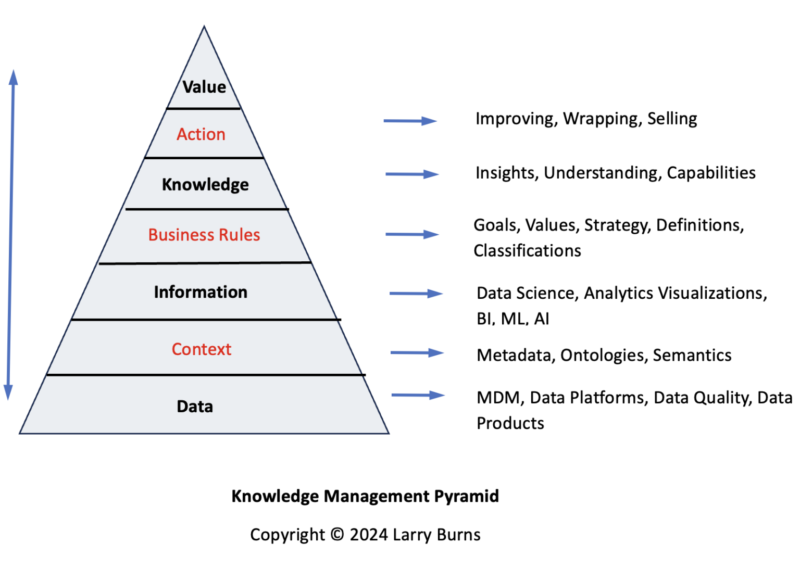
This model shows us two very important components of information governance: context and business rules. Context (which includes metadata, semantics, and ontologies) helps us to define, classify, and organize data so that it can be effectively communicated and consumed as information. Business rules (which include organizational goals, strategies, and values) help us to decide which specific streams of information must be directed to which groups of people in order to address specific organizational problems and needs.
I like to put it this way: Business rules focus and direct streams of information in much the same way that a prism focuses and directs streams of light. Context ensures that our streams of content-laden information are effective; business rules ensure that they are directed where they will do the most good.
These two capabilities are especially essential in this new age of agentic AI. As I’ve pointed out before, traditionally most information context and business rules are buried deeply, either in data models, database code, or application code, and are available (and understandable) only to a small handful of people in IT (many of whom have already left the company!).
But to support agentic AI, it will become necessary for both information context and business rules to exist external to both applications and databases/data models, and to exist in a form that can be consumed by machines. This, to me, is the single greatest upcoming challenge in IT, and I don’t think our current level of understanding (or our tooling) are up to it. We need a much more knowledgeable and highly trained workforce, and much better tools than we have right now.
Let me end with a couple of points: First of all, the laws of economics apply to information the same way they apply to everything else. The cost of the information needed to solve a problem must never exceed the cost of the problem. The more problems you can solve with the same information, the more economical that information is. And there is a definite opportunity cost involved in creating vast stores of data and information that aren’t being used to solve current business problems and take advantage of current business opportunities. So, keep your data and information governance efforts laser-focused on business needs, business opportunities, and business value.
Finally, note that as we move up the pyramid, the role of actual human beings becomes more pronounced, and more important. At lower levels of the pyramid, a lot of the work can be automated by tools and agents. But at the level where decisions need to be made as to who needs what information and what knowledge to solve a specific business problem or meet a specific business need, the involvement of knowledgeable people (i.e., shamans) becomes more and more imperative.
In the next article, I’ll expand more on these ideas, and particularly their application to knowledge management and the creation of business value. Stay tuned!
[1] The principles and techniques of human-centered design are explained clearly in an excellent book called The Field Guide to Human-Centered Design. This book is available for purchase on the IDEO.org website. This website also contains many examples of how IDEO applies HCD to a number of different problem spaces in the developing world.
[2] Davenport, Thomas. Information Ecology (Oxford University Press, 1997), Chapter 3.
[3] Hardin, Garrett. Filters Against Folly: How to Survive Despite Economists, Ecologists, and the Merely Eloquent (New York: Penguin Books, 1985).
Applied Data Governance Practitioner Certification
Validate your expertise and take your career to the next level.