It seems like everybody’s talking about governance these days. Data governance, the principles that are addressed in the DAMA DMBOK, and the writings of Robert Seiner. BI governance, including many of the issues covered in my book Growing Business Intelligence. And now AI governance, an emerging topic of increasing concern to data and BI professionals. What do they do? How are they similar? How are they different? And how do we actually implement them?
In the first article in this series, I explained how governance processes of any kind are fundamentally the same as asset management. I then described how asset management, and specifically the management of data and information assets, is supposed to work.
Optimize Your Data Catalog
Learn how to successfully implement, govern, and drive the adoption of an enterprise data catalog.

In this article, I’m going to begin a deep dive into the various types of governance activities, beginning with data governance. For each type of governance, we need to address the following questions:
- What is the intended purpose of this type of governance?
- Who are the intended beneficiaries of this governance?
- How should this governance be done? And by whom?
- Why are these governance activities important?
I’d like to start by introducing my own version of a graphic I’m sure you’re all familiar with: the Data/Information/Knowledge pyramid:
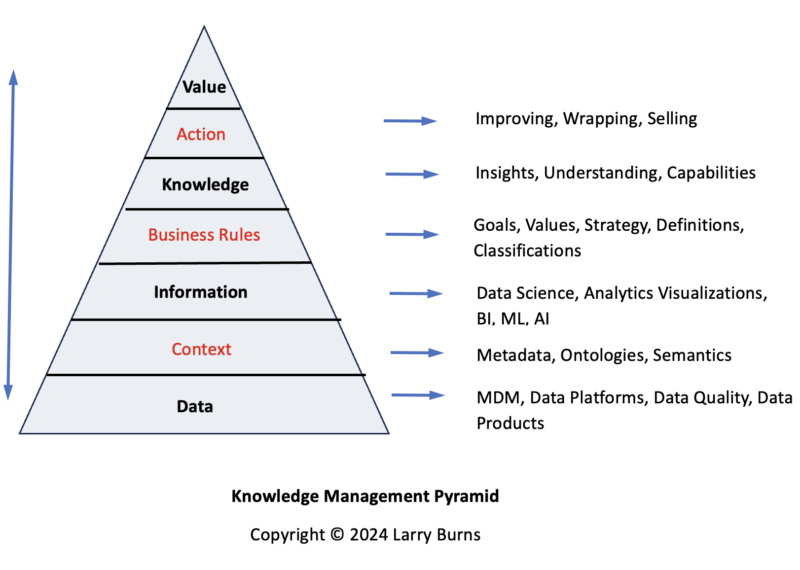
In the above diagram, I’m attempting to illustrate in greater detail what is actually involved in transforming data into business value:
- First, data has to be turned into streams of content-laden information. This is done by adding context (i.e., metadata) to the data, while also ensuring that the content of the data meets the data quality (“fitness for purpose”) requirements.
- Then, the streams of information are turned into business knowledge. This is done by applying business rules to the information. Business rules are used to focus and direct the streams of information to where they are most needed to benefit the business, in much the same way as a prism focuses and directs beams of light.
- Finally, knowledge is turned into business value through action; that is, the knowledge gained is acted upon and becomes tacit (i.e., experiential). The enterprise becomes more aware of what works and what doesn’t, and increases its store of operational expertise.
This process operates in both directions. As organizations learn what works and what doesn’t, they create knowledge assets that, in turn, are used to fuel streams of information that create even more knowledge and expertise, in a sort of self-reinforcing loop. The knowledge assets, in effect, become data, and the data becomes information, and the information becomes more knowledge.
In this series of articles, I’m going to make the argument that three separate types of governance processes apply to the turning of data into information, of information into knowledge, and of knowledge into business value. These three processes are usually referred to as data management, information management, and knowledge management.
It’s also important to understand that there is a difference between value creation and value realization. Barbara Wixom et al. liken this to the difference between growing a fruit tree and selling the fruit [i]. The fruit tree represents potential value; the sold fruit represents actual value. The fruit tree is a resource; the sold fruit is an asset. This goes back to a critique I’ve made against the DAMA DMBOK: the DMBOK essentially tells you how to grow fruit trees; that is, it tells you how to build data and information artifacts. But, as I explained in the last article, business value is never created from things, it is only created from processes. Buildings and inventory and fleets of trucks and employees and data products do not, by themselves, create business value. Business value is created when these things are managed in a value-producing way. This is why I say that data is not an asset per se, but the data management process can be. The DMBOK needs to describe the business process of realizing value from data and information. That is, it needs to explain not only how to grow the fruit trees, but also how to sell the fruit!
Data governance (the data asset management process) exists for the purpose of creating and managing data assets in a way that generates streams of content-laden information that links business stakeholders together in innovative and value-producing ways. And, as I’ve already pointed out, this value creation stems from empowering stakeholders to do things for themselves, rather than waiting for other people to do things for them.
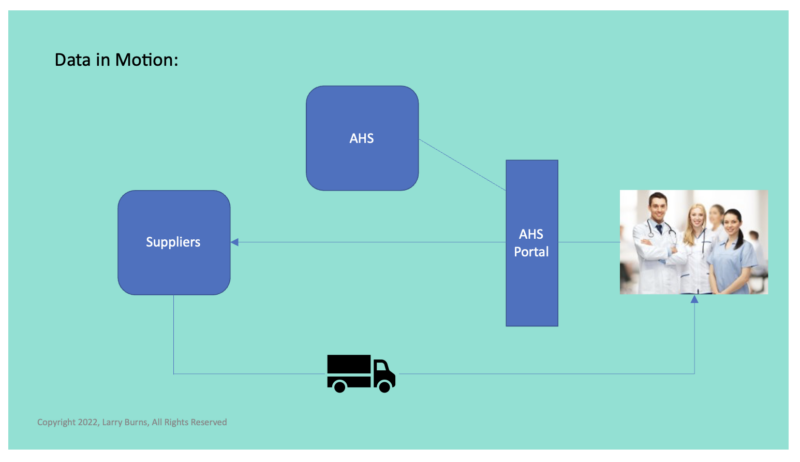
One example I like to use is American Hospital Supply (AHS). For years, AHS had a very typical business model that involved buying medical supplies from wholesalers, storing them in warehouses, and shipping them via fleets of trucks to customers. Realizing that their business model was no longer viable in the Age of Amazon, they created an online portal that allows their customers to order directly from their suppliers! The customers get more choices and faster service, the suppliers get more business, and AHS gets subscription revenue from the portal and a percentage of each online order from the suppliers. Plus, they no longer have to incur the cost of maintaining warehouses and fleets of trucks.
As I noted in the first article, data needs to be managed (i.e., governed) in ways that facilitate reuse and sharing, ensure that the quality of the data is fit for its intended purpose(s), and enable it to easily be consumed into streams of informational content. This includes managing not only the data itself, but the metadata (i.e., context) that enables the data to be understood and shared effectively,
This brings me to a very important point that I’m going to be reiterating throughout this series of articles: In order to facilitate the sharing and reuse of data, information, and knowledge, it is not enough to simply create artifacts (or products as we like to say now) and hope to chance that somebody will find them and put them to use. No, in order to get maximum value from our data, information, and knowledge assets, we must produce Marketplaces and teach our business customers how to use them!
In order to be effective, marketplaces must meet the following requirements:
- Informational content needs to be made available in an easily discoverable and consumable form.
- Adequate metadata (context) must be provided so that users can easily find the content that will meet their particular business need.
- Users must be able to trust both the quality and timeliness of the content, and the expertise and authority of the content provider(s).
- The content must be managed at the correct level of the organization (either at the business domain level, or higher for content that is shared or owned across business units).
- The culture of the organization must encourage and reward both the creation and sharing of content by providers and the consumption and use of content by business consumers.
- Content must be made available only to authorized users and protected from access by unauthorized outsiders.
- The content in the marketplace must be attuned to the requirements, goals, values, objectives and needs of the business.
- Use of the marketplace must be actively promoted throughout the enterprise, and business users must be trained in the use of the marketplace to find solutions to their business problems and needs. “Build it and they will come” has never been a viable business strategy.
- The organization itself must value the creation, sharing and use of information and knowledge. That is, it must be a “data-driven” or “knowledge-driven” organization, where business decisions are based on knowledge and expertise, not politics or “gut instinct”.
Here are some additional pieces of advice on data governance:
- Data governance needs to be centered around business needs and goals, not data or database standards.
- Define data governance as part of the process of creating business value in your organization. [ii] If you focus your data governance efforts on creating business value, then it will be “non-invasive” by definition!
- The people who are “data stewards” are the people who are using data and information to create business value.
- Understand that business people don’t “own” or manage data. They own and manage business processes that use data. Focus on understanding and improving these business processes, and then determine what data is needed to do it.
- Focus on data in motion, not data at rest. That is, make sure the content in your marketplace actively supports current business processes and business needs, and is not just sitting in a repository taking up space.
- Take an Agile approach. Start small, with the most urgent and important business needs, and add value continually and iteratively.
- Create and manage the content at the correct level of the organization. Most of the content can probably be managed at the domain (business area) or subdomain level. But be careful about content whose definition and usage spans business areas, or whose application is organization-wide (i.e., master data).
- Make sure that all content created and published is accompanied by the necessary metadata (i.e., context) that explains where it comes from, who created it, how current it is, what business functions or processes it supports, what quality characteristics it meets, what its privacy, security, and retention characteristics are, and what business purposes it can and cannot be used for.
- Give recognition to, and respect the legitimate interests of, all affected stakeholders, including the people who create, curate, and manage the content, as well as the business users who use it.
In the next article, I’ll expand more on this idea of the marketplace, and explain its application to information and knowledge management, and to BI and AI governance. Stay tuned!
[i] Wixom, Barbara H., Cynthia M. Beath and Leslie Owens. Data is Everybody’s Business (MIT Press, 2023), pp. 12-15.
[ii] One obstacle to making data governance a part of an organization’s value-creation process is that a lot of organizations don’t have a defined process for creating business value. Try asking some of your executives the question, “What is this company’s defined process for creating business value?” and see what they say.
Applied Data Governance Practitioner Certification
Validate your expertise and take your career to the next level.