Healthcare organizations are entering a new phase of AI adoption. The industry is no longer experimenting only with static predictive models or back-office automation. It is now deploying AI agents that can retrieve records, summarize histories, trigger workflows, draft communications, andincreasingly influence decisions that affect patient care and operations.
That shift creates a problem most compliance programs are not built to solve.
When an AI agent makes thousands of micro-decisions in real time, traditional auditing starts to break down. Human reviewers cannot meaningfully inspect every action, prompt, data access event, and output before risk occurs. In healthcare – where privacy, trust, and patient safety are inseparable – that gap is more than an operational inconvenience. It is a data governance failure waiting to happen.
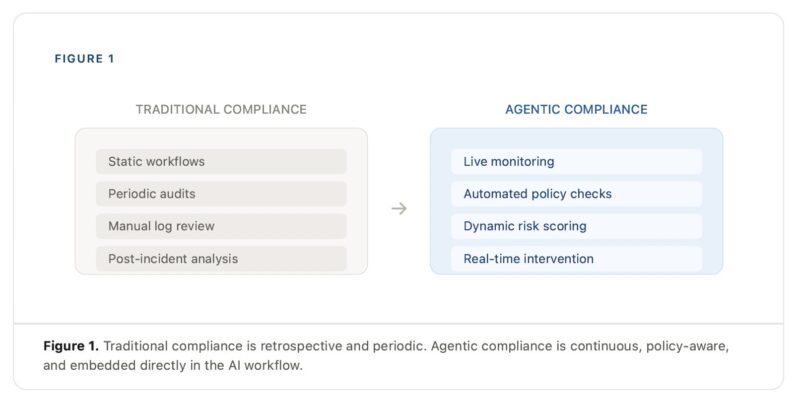
This is where agentic compliance comes in: the idea that AI itself must become part of the compliance architecture. The next generation of governance may require a new kind of watcher: AI auditing AI.
Data Architecture Workshop
Learn how to design unified, future-ready data architectures that bring together operational, analytical, and AI data – December 1-2, 2026.

The End of Manual Auditing as We Know It
Traditional compliance was designed for slower, more predictable systems. A workflow could be documented, a rule could be reviewed, and logs could be checked after the fact. That model worked when software was deterministic and decision paths were relatively stable.
Agentic AI has changed the equation. These systems do not simply execute fixed commands – they interpret goals, retrieve information, choose tools, respond to changing context, and sometimes behave in ways that are difficult to anticipate from design documents alone. Their outputs are shaped not just by code, but by prompts, retrieved content, system instructions, integrations, permissions, and live environmental inputs.
That makes old audit models inadequate for three reasons, detailed below in figure 2.
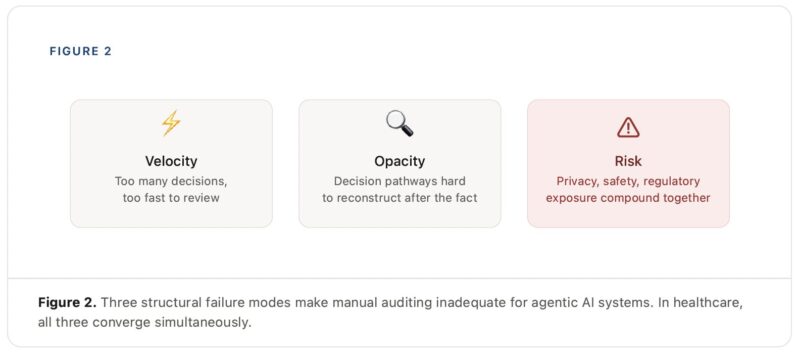
In healthcare, an unauthorized disclosure of protected health information, an unsupported clinical suggestion, or an off-policy use of patient data is not just a technical defect. It is a legal and ethical event.
What Is Agentic Compliance?
Agentic compliance is the practice of deploying specialized oversight systems – governance bots, supervisory agents, compliance layers – to monitor operational AI agents in real time. These systems do not replace privacy officers, legal teams, or security professionals. They extend them.
Think of it as a digital shadow. For every high-impact AI agent, there is a corresponding governance function tracking what data is being accessed, what actions are being taken, what boundaries apply, and whether the system is operating within approved limits. This transforms compliance from a retrospective exercise into an active control mechanism.
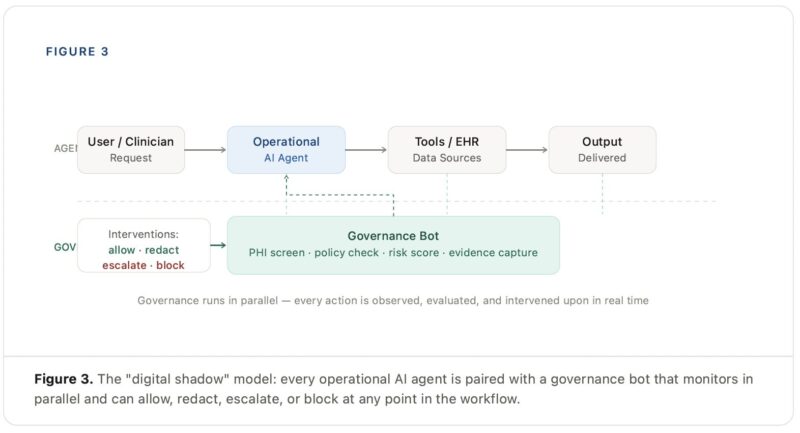
Why Healthcare Needs a “Governance Bot”
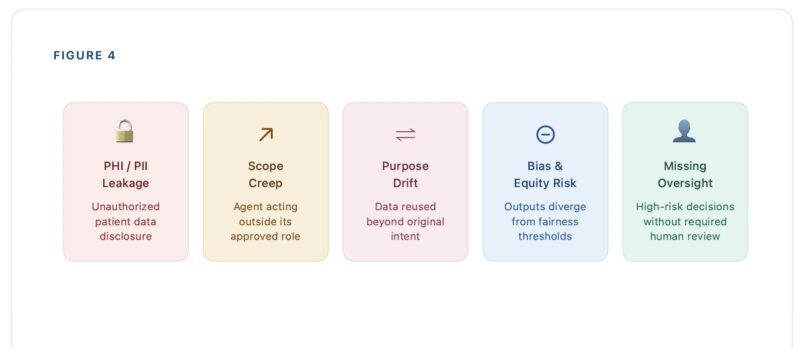
Healthcare is one of the clearest use cases for agentic compliance because the margin for error is so small. An AI scheduling assistant should not drift intoclinical triage. A documentation assistant should not expose unnecessary patient data. A care-coordination bot should not repurpose sensitive information for analytics without the appropriate basis and controls.
A governance bot can help monitor across five critical risk domains:
From Static Documentation to Living DPIAs
One of the most promising aspects of agentic compliance is how it could reshape the data protection impact assessment (DPIA). Too often, DPIAs are treated as static compliance artifacts: completed before deployment, stored in a shared drive, and revisited only when someone asks for them. That approachmay be barely sufficient for conventional applications. It is not sufficient foradaptive AI systems.
Agentic AI systems change in practice even when their core architecturestays the same. New prompts are introduced. New tools are connected. New workflows are enabled. Risk evolves in production.
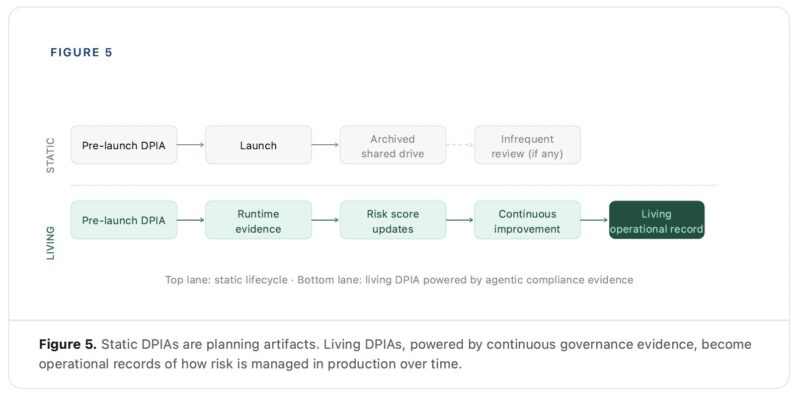
In an agentic compliance model, the governance layer continuously generates evidence about how the system behaves in reality – updating risk posture dynamically based on actual data access, actual outputs, escalation frequency, failed policy checks, and observed edge cases. For privacy and legal teams, this is a major shift: Instead of relying only on assumptions made before deployment, they gain ongoing visibility into whether those assumptions still hold.
Audit-by-Design, Not Audit-After-the-Fact
The broader lesson is that compliance can no longer sit outside the AI architecture. It must be built into it. Rather than waiting for an incident review, organizations can embed governance checkpoints throughout the entire lifecycle of an AI action.
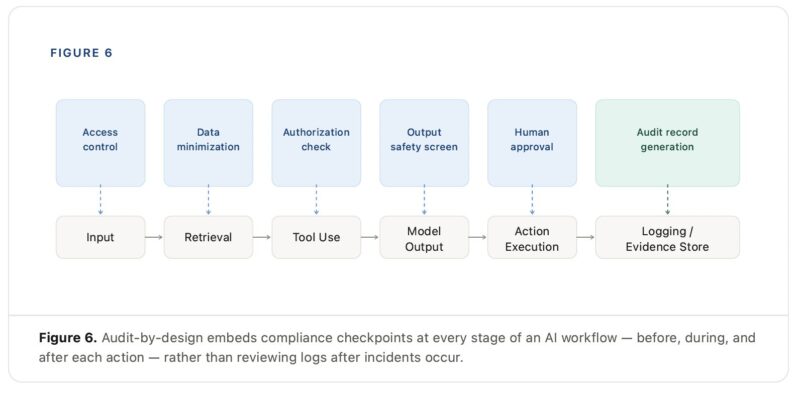
A Practical Operating Model for Agentic Compliance
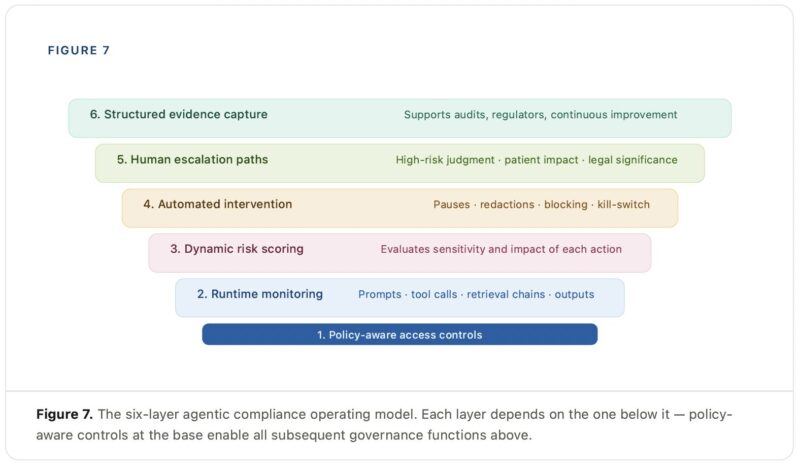
For healthcare organizations, agentic compliance should not be framed as a futuristic moonshot. It should be approached as an operational design principle built on six core layers.
Who Guards the Guardians?
That question is no longer philosophical. It is now architectural.
As healthcare organizations adopt more autonomous systems, they cannotassume human oversight alone will scale with the speed and complexity of AI behavior.
Governance must become embedded, adaptive, and continuous.
Agentic compliance offers a path forward. It acknowledges a simple reality:If AI is going to operate inside sensitive clinical and administrative environments, compliance cannot remain a slow, manual, after-the-fact process. It must become real-time, evidence-driven, and built into the system itself.
The future of responsible healthcare AI will not depend only on what autonomous agents can do. It will depend on what their guardians can stop.
Build your AI governance skills in 2026.
Explore training programs on AI governance, data governance, and compliance for data practitioners.